Transform Customer Support with an AI Chatbot for Business
Think of an AI chatbot for your business as a new team member. But this isn’t just any team member. This one works 24/7, never takes a break, speaks every customer’s language, and has already memorized every piece of your documentation.
That’s the power of a modern AI chatbot. It’s not just a tool; it’s a strategic asset designed to automate how you handle support tickets and provide instant, accurate answers around the clock.
Why an AI Chatbot Is Your Next Strategic Hire
Forget the rigid, frustrating bots from a few years ago that could only spit out a few canned responses. Today’s AI has evolved into a core part of a company’s support strategy, acting less like a simple script and more like an intelligent employee.
Imagine hiring someone who already knows the answer to every common question before their first day. This new “colleague” can fundamentally change your customer support from a cost center into a real driver for growth.
Driving Efficiency and Customer Satisfaction
At its core, a modern chatbot is built to handle the repetitive, time-consuming tasks that bog down your human agents. Think about all the time spent on password resets, order status updates, or explaining basic features. The chatbot can resolve these instantly.
This isn’t just about being faster; it’s about making your entire team smarter. When the bot takes care of the basics, your expert agents are free to focus on the complex, high-value problems that actually require a human touch. It creates a far more efficient workflow and lets your best people do their best work. This is the same power that lets a small business compete head-to-head with much larger companies.
A Data-Driven Approach to Support
One of the most powerful aspects of a business chatbot is its ability to learn and get better over time. These systems don’t just follow a script; they actively analyze your help articles, user guides, and past ticket resolutions to understand the context behind a question and provide genuinely helpful solutions.
The results speak for themselves. Customer support now makes up a massive 42.4% of the entire chatbot market, proving just how effective it is. In fact, 51% of consumers say they actually prefer using bots for immediate service. It’s no surprise that businesses often see up to a 200% ROI after implementing these tools.
By automating ticket handling and generating context-aware responses 24/7, a business chatbot ensures no customer is left waiting. This isn’t just about answering questions-it’s about building loyalty through consistently reliable service.
At the end of the day, bringing an AI chatbot into your business is a strategic move. You’re investing in a system that doesn’t just close tickets but also makes your customers happier, empowers your human team, and builds a scalable foundation for growth.
Understanding the Core AI Chatbot Capabilities
So, what really separates a modern AI chatbot from the clunky, scripted bots of the past? It’s the difference between a simple FAQ lookup and an expert triage nurse in a busy emergency room.
A great chatbot doesn’t just say “hello.” It immediately assesses the situation, figures out what the customer needs, and gets the request to the right person or system to solve it. This isn’t magic-it’s built on a foundation of a few core capabilities that work together to streamline your entire support operation.
Intelligent Ticket Automation
The first and most powerful capability is intelligent ticket automation. This is about so much more than just logging a new issue. The moment a message comes in, the AI analyzes it to understand exactly what the customer is asking for.
Without any human touching a button, the bot can instantly:
- Tag and Categorize: It reads the message and applies the right tags, like “billing,” “bug report,” or “feature request.”
- Prioritize Issues: It can tell the difference between a critical system-down emergency and a simple how-to question, setting the priority so your team knows what to tackle first.
- Resolve Simple Requests: For those common, repetitive questions-password resets, order status updates, and the like-the bot can provide an instant answer and close the ticket right away.
This is the stuff that frees your support team from the grind of repetitive tasks, letting them focus on the complex problems where they can make a real difference. If you want to get into the nitty-gritty, our guide on how to automate ticket responses with AI breaks it down step-by-step.
Smart Routing and Escalation
Once the chatbot understands the ticket, its next job is to act as a hyper-efficient dispatcher. This is smart routing, and it’s all about making sure every single query lands in the right queue on the very first try.
A truly smart chatbot knows that an invoice question has to go straight to the finance team, while a software glitch needs to be flagged for engineering. This completely cuts out the manual, error-prone process of agents playing hot potato with tickets, which just wastes time and frustrates everyone.
Just as important is knowing when to hand things off to a person. The best AI chatbots understand their own limits. They can sense when a customer is getting frustrated, when an issue is too complex, or when the topic is sensitive. In those moments, the bot seamlessly transfers the entire conversation-context and all-to a human agent.
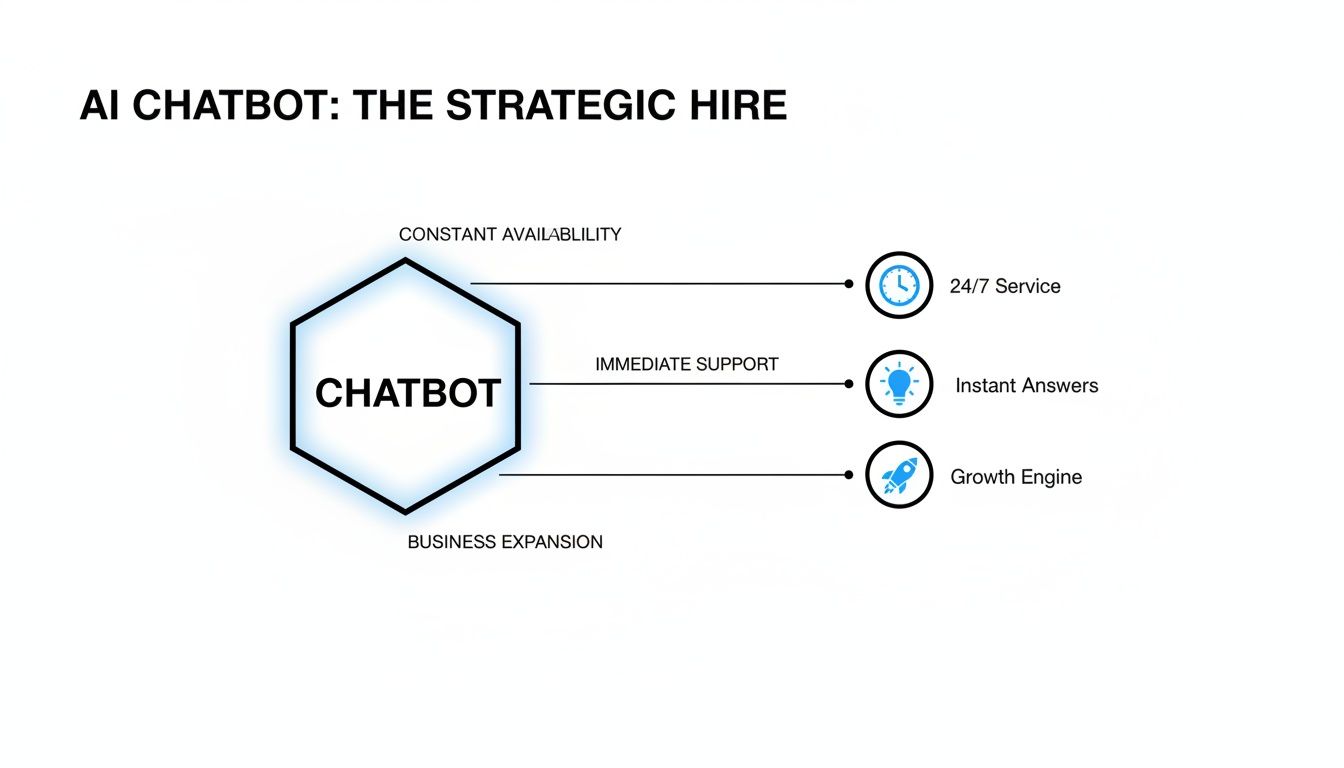
As you can see, the bot quickly becomes more than just a cost-saving tool. It’s a strategic asset that powers 24/7 service and drives real business growth.
Continuous Learning from Knowledge Sources
Finally, a top-tier AI chatbot isn’t a static program; it’s a learning machine. Its intelligence isn’t programmed line by line. Instead, it comes from its ability to constantly absorb and understand your company’s unique knowledge.
A great AI chatbot doesn’t just pull from a pre-written script. It learns from your help center articles, FAQs, user guides, and even technical API documentation to build a deep, contextual understanding of your products and services.
This ensures every answer is accurate and perfectly aligned with your official information. When you update a help doc, the bot learns. When you add a new feature, the bot incorporates that knowledge. This is what keeps your chatbot relevant, trustworthy, and genuinely helpful to customers for the long haul.
Let’s be real-beyond all the fancy tech talk, what does an AI chatbot actually do for your business? We’re not just talking about answering questions a little faster. The real impact hits your bottom line, your team’s workload, and your customers’ happiness.
Think of a chatbot as the newest, most efficient member of your support team. It takes on the flood of simple, repetitive questions-the “what’s my order status?” or “how do I reset my password?” queries-freeing up your human agents to tackle the tricky stuff that needs a human touch. This isn’t just a small tweak; it’s a strategic shift that directly affects your budget and your team’s sanity.
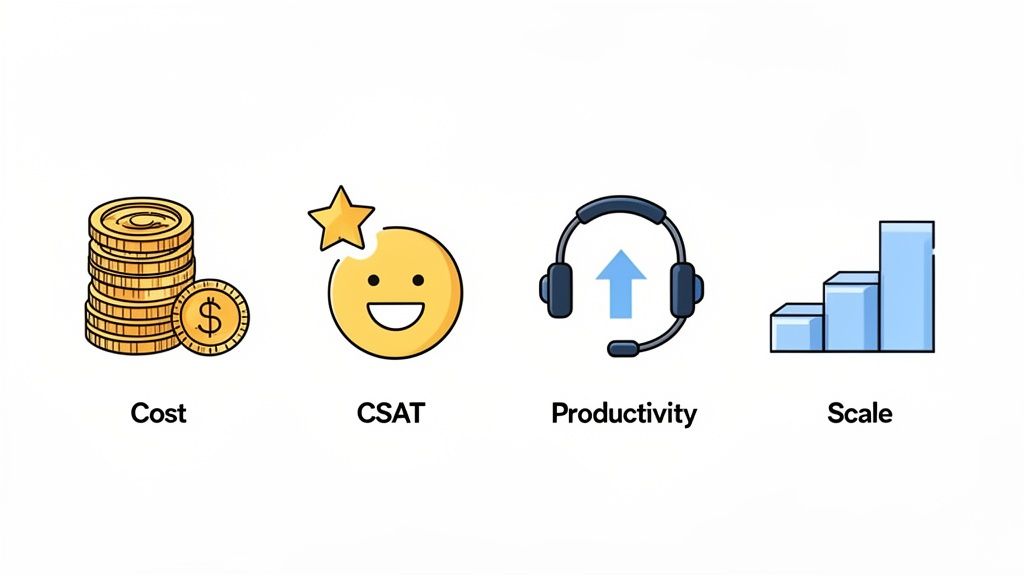
Slash Your Operational Costs
One of the first things you’ll notice is a serious drop in operational costs. A single chatbot can juggle thousands of conversations at once, a task that would require a small army of human agents. This means you can handle a growing tide of customer inquiries without having to constantly expand your support headcount.
Every ticket the bot resolves on its own is one less ticket your team has to handle. That simple fact frees up a significant chunk of your budget, which can be put back into growing other parts of the business. For a small business, where every dollar is precious, this isn’t just a perk-it’s a game-changer. The bot pays for itself by optimizing your most valuable asset: your people’s time.
Make Customers Happier with 24/7 Support
Today’s customers don’t operate on a 9-to-5 schedule. They expect answers now, whether it’s 2 PM on a Tuesday or 2 AM on a Sunday. A chatbot delivers that instant, 24/7 support, making sure no customer is left waiting.
Instead of getting an auto-reply saying “we’ll get back to you in 24-48 hours,” they get their problem solved on the spot. That kind of instant gratification doesn’t just solve a problem; it builds real trust and loyalty with your brand.
It turns out, customers are ready for this. A solid 67% of consumers globally used a chatbot for support last year. And 69% of companies that have adopted AI report a direct improvement in their service quality. People are increasingly choosing bots for one simple reason: speed.
This always-on service model quickly becomes the new standard for your brand’s reliability.
Boost Your Team’s Productivity and Morale
What happens when you take all the boring, repetitive questions off your agents’ plates? They stop being human FAQs and start being expert problem-solvers. This is a massive win for both their productivity and their job satisfaction.
With their time freed up, your agents can focus on what they do best:
- Solving gnarly problems: They can dig into the complex technical issues that require deep expertise and creative thinking.
- Building real relationships: They have the bandwidth for longer, more empathetic conversations with high-value customers.
- Thinking ahead: Instead of just putting out fires, they can spot trends and suggest improvements to prevent problems from happening in the first place.
Their work becomes more meaningful and the business gets more value out of their expertise. When you look at the broader workflow automation benefits, you see how a single tool can elevate an entire team’s function.
Grow Your Business Without Growing Pains
As your company expands, so does the number of customer questions. The old way to scale support was to just keep hiring more people-a slow, expensive process. A chatbot offers a much smarter way to grow.
Whether you’re dealing with a hundred support tickets or a hundred thousand, the bot handles the load without breaking a sweat. Your support operations can expand right alongside your customer base, with none of the usual bottlenecks. It’s a foundation for growth that doesn’t crack under pressure.
AI Chatbot Impact on Key Business Metrics
So, what does this all look like in terms of hard numbers? The table below breaks down the typical improvements businesses see after bringing an AI chatbot on board. It shows a clear line from implementation to measurable results in cost, efficiency, and customer experience.
| Business Metric | Average Improvement with AI Chatbot | Primary Driver |
|---|---|---|
| Cost Per Contact | 25-40% Reduction | Automating repetitive tier-1 inquiries, reducing the need for human agent intervention for common questions. |
| First Response Time | 90% Improvement | Providing instant, 24/7 answers, eliminating wait times for customers outside of business hours. |
| Ticket Resolution Time | 30-50% Faster | Resolving simple issues immediately without manual handoffs or agent research time. |
| Agent Productivity | 20-35% Increase | Freeing up human agents to focus on complex, high-value tasks instead of routine queries. |
| Customer Satisfaction (CSAT) | 10-25% Uplift | Delivering instant solutions and consistent service quality, which directly improves customer perception. |
Ultimately, implementing an AI chatbot isn’t just about adding a new tool-it’s about fundamentally rethinking how you support your customers and empower your team. The numbers clearly show that it’s an investment that pays dividends across the board.
How to Choose the Best AI Chatbot for Your Business
Picking the right AI chatbot is a huge decision, one that will define your customer support for a long time. It’s not about finding the tool with the longest feature list but about finding a partner that plugs into your existing workflow and actually gets results. Whether you’re a startup or a large enterprise, knowing how to choose a customer support chatbot is key. To find the best ai chatbot for business, you need to look past the sales pitch and focus on the non-negotiables that guarantee a good, long-term fit.
Assess Integration Capabilities
First things first: how well does the chatbot for business play with others? An AI tool that works in a silo isn’t an asset; it’s a headache waiting to happen. It has to connect flawlessly with the tools you already rely on, especially your helpdesk (like Zendesk, Intercom, or Jira) and your CRM.
A truly seamless integration means the chatbot can:
- Access Customer History: Pull up past interactions from your CRM to have a personalized, context-aware conversation.
- Create and Update Tickets: Automatically log every interaction in your helpdesk so your team doesn’t have to do it manually.
- Sync Data in Real-Time: Make sure the bot and your human agents are always looking at the same, up-to-the-minute information.
Without these deep connections, you’re just creating more work for your team. A good chatbot should feel like a natural extension of your software stack, giving you one unified view of every customer.
Examine the Learning and Training Process
A chatbot is only as smart as the information it’s given. That’s why you have to dig into how it learns. Older bots were a nightmare to set up, forcing you to write hundreds of clunky “if-this-then-that” rules. A modern chatbot for small business should be far more intelligent.
The best platforms learn directly from the knowledge you’ve already created. Ask yourself: can the chatbot actually read and understand your company’s unique documentation?
A critical factor is the bot’s ability to learn from varied content types, including user guides, API documentation, FAQs, and even past support tickets. The easier it is for the AI to absorb and structure this knowledge, the faster it will deliver accurate and context-aware answers.
This self-learning capability is what separates the good from the great. It means less manual work and a bot that stays up-to-date. The right platform should make this as simple as pointing the AI to your help center and letting it go to work.
Analyze the Human-in-the-Loop Workflow
Even the smartest AI needs a human co-pilot. A “human-in-the-loop” workflow isn’t a sign that the bot is weak; it’s a feature of a smart, well-designed system. This lets your human agents act as supervisors, guaranteeing quality and handling tricky escalations without a hitch. One of the greatest benefits of chatbot for business is this synergy.
When you’re evaluating a chatbot, here’s what to ask:
- Can agents review AI-suggested replies? The system should let an agent quickly approve or edit a bot’s suggested answer before it goes to the customer.
- How seamless is the handoff? When a customer needs a human, can the bot transfer the entire conversation history to an agent so the customer doesn’t have to repeat themselves?
- Does the AI learn from corrections? Every time an agent edits a response, it’s a learning moment. The AI should use that feedback to get smarter.
This partnership between AI and people is where you’ll see the biggest benefits, especially for an ai chatbot for small business where every agent’s time is precious.
Verify Security and Compliance Standards
Finally, you’re trusting this tool with sensitive customer data. Security can’t be an afterthought. Your chosen platform must meet serious security and compliance standards to protect your business and your customers.
Here’s what to look for:
- Data Encryption: All data-at rest and in transit-needs to be encrypted.
- Compliance Certifications: Look for proof of their commitment, like SOC 2 Type II, which shows they follow enterprise-grade security practices.
- Access Controls: The platform should give you fine-grained control over who can access what data and configure the bot’s settings.
As businesses lean more on AI, customer expectations are shooting up. Globally, 80% of organizations are planning to use generative AI to improve customer experiences. With 48% of consumers already struggling to tell bots from humans, picking a platform that delivers human-like precision is critical. Find out more about the surge in AI business adoption. This makes your choice more than just a technical one-it’s a fundamental business decision.
Implementing Your AI Chatbot for a Successful Launch
Getting an AI chatbot for business up and running shouldn’t be a drawn-out IT project. With today’s platforms, you can go from an idea to a fully working bot in a few hours, not weeks. The whole process really just boils down to a handful of straightforward steps centered on good preparation and smart collaboration.
The journey doesn’t start with code; it starts with the knowledge you already have. Think of it like onboarding a new team member. Your AI needs the right training materials to study so it can start answering customer questions accurately from day one. This is the bedrock of a successful launch.
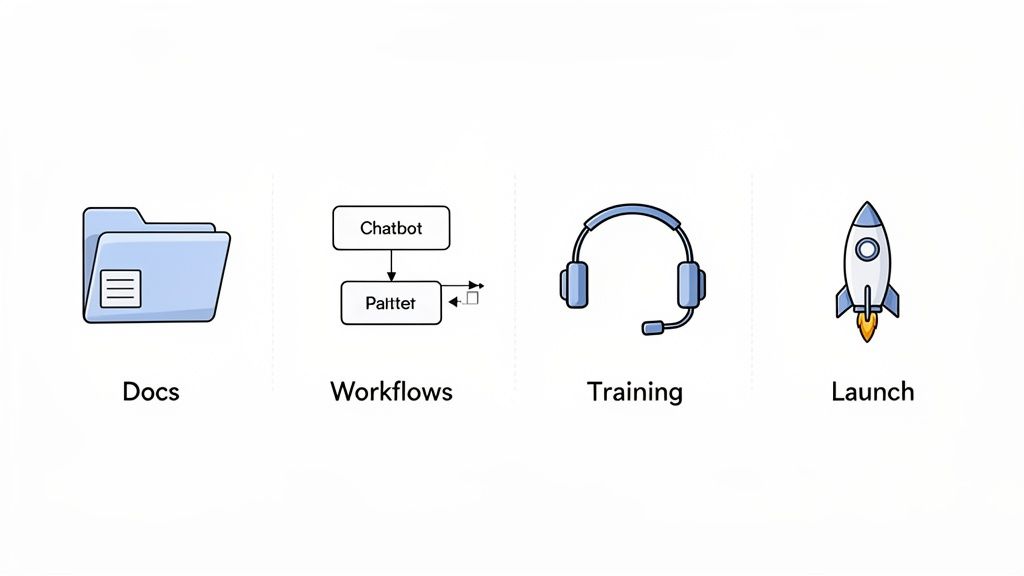
Prepare Your Knowledge Sources
Your chatbot is only as smart as the information you give it. The goal here is to create a single source of truth that the AI can digest and learn from. Start by pulling together your most important documents.
This usually includes:
- FAQs and Help Center Articles: These are gold. Gather your most common customer questions and their official answers. Make sure everything is up-to-date and easy to understand.
- User Guides and Manuals: Give the bot your detailed product docs so it can walk users through features or help them troubleshoot.
- API Documentation: If you have a more technical product, feeding the bot your API docs lets it help developers and power users directly.
Getting these materials organized upfront means your bot is trained on accurate, company-approved info right out of the gate. This is one of the biggest benefits of chatbot for business implementation-it puts the assets you’ve already created to work in a new way.
Define Your Initial Workflows
Once the bot has its knowledge base, you need to tell it what to do with incoming questions. This is where you map out your initial workflows for routing and escalation, ensuring a clean handoff between the AI and your human agents. You’re essentially setting the rules of engagement.
Think through a few common scenarios:
- Tagging and Routing: A customer asks about a recent invoice. The bot should be smart enough to tag that ticket as “Billing” and send it straight to the finance team’s queue.
- Smart Escalation: A user flags a major bug in your software. The bot needs to recognize the urgency, tag it “High Priority,” and immediately escalate it to an on-call engineer.
- Handoff Protocol: If a customer gets frustrated or asks something way out of left field, the bot should know to pass the entire conversation and context over to a live agent, no questions asked.
These simple rules turn your chatbot for business from a basic Q&A machine into an intelligent dispatcher for your whole support team.
Train Your Team for Collaboration
The last piece of the puzzle is getting your human agents ready to work with their new AI teammate. This is not about replacing people; it’s about making them more effective. Your team’s role will shift away from answering the same questions over and over to supervising the AI and tackling the most important customer issues.
Train your agents to review AI-suggested responses, take over complex chats when needed, and provide feedback that helps the bot learn. This “human-in-the-loop” approach makes your team expert problem-solvers instead of just ticket-closers.
This collaborative model is a game-changer for an AI chatbot for small business, letting a lean team manage a much higher volume of customer conversations.
Once your knowledge is prepped, your workflows are defined, and your team is on board, you’re ready to go live. The final technical steps are usually the easiest part-you can even learn how to embed an AI chatbot on your website in just a few minutes.
Measuring Success and Proving Your ROI
Bringing an AI chatbot for business into your workflow is an investment, plain and simple. And like any good investment, you need to be able to prove its value with cold, hard data. We’re moving past “it feels like it’s helping” and into the world of key performance indicators (KPIs) that show a real, tangible return.
When you track the right numbers, your chatbot stops being a “nice-to-have” and becomes a strategic part of your operation. It’s how you build a rock-solid business case for AI and show stakeholders exactly how automation is making your support faster, leaner, and more effective.
Key Metrics to Track
To really understand your chatbot’s performance, you don’t need a million different data points. Just focus on a few core metrics that tell the story of efficiency and customer happiness.
- First Response Time (FRT): This one is simple: how long does it take for a customer to get that first reply? With an AI chatbot, the answer is almost instant. This is a massive improvement over human-only teams and a huge win for the customer experience.
- Ticket Deflection Rate: What percentage of questions get fully answered by the bot without ever needing a human? Every single ticket deflected is a direct cost saving and frees up your team for more complex issues.
- Customer Satisfaction (CSAT): A quick “How did we do?” survey after a chat is all it takes. When you see high CSAT scores coming from bot interactions, you have clear proof that your AI is not just fast, but genuinely helpful.
These numbers give you the solid evidence you need to prove your chatbot is pulling its weight, improving the customer journey, and easing the burden on your support agents.
Calculating Your Return on Investment
Let’s make the benefits of your chatbot concrete by calculating its ROI. The formula itself is pretty straightforward: (Financial Gain - Investment Cost) / Investment Cost. The real trick is nailing down the “Financial Gain” part, which mostly comes from saving on labor costs and giving your agents more bandwidth.
A huge win with any chatbot for business is its ability to handle a higher volume of inquiries without you having to hire more people. Each ticket the bot deflects is money saved, and every minute it gives back to your agents is pure productivity.
First, figure out what it costs, on average, for a human agent to handle one ticket. Once you have that number, just multiply it by the number of tickets your chatbot deflects every month. Boom-that’s your direct monthly savings. For a deeper dive, you can use our helpful help desk ROI calculator to play with different numbers and see the potential.
But it doesn’t stop at internal metrics. A modern approach to ROI also includes tracking your brand’s visibility in major AI models like ChatGPT and other LLMs. This ensures your brand is being represented accurately wherever customers are finding information. When you measure it right, a well-implemented AI chatbot for small business will prove it pays for itself many times over.
Got Questions About AI Business Chatbots?
Diving into the world of AI can bring up a lot of questions. It’s only natural to wonder about the cost, the setup process, and what it all means for your team as you consider adding an AI chatbot for business to your workflow. Let’s tackle some of the most common ones we hear.
One of the first things people ask is about the setup time. Thankfully, modern platforms are built for speed. If you have existing documentation-like FAQs, help articles, and user guides-systems can learn directly from them and be up and running in a matter of hours, not weeks. The technical lift is minimal; the real work is just getting your knowledge base organized.
Will an AI Chatbot Replace My Team?
This is a big one, and it’s mostly a myth. Chatbots aren’t here to replace human agents. It’s actually the opposite-the goal is to make your existing team even better.
The real benefits of a chatbot for business shine when it augments your team. The bot takes on the high-volume, repetitive questions that eat up so much time. This frees up your human experts to focus on the complex, nuanced customer issues that genuinely require a human touch, empathy, and critical thinking. This “human-in-the-loop” model is the secret to getting the best AI chatbot for business to work in perfect sync with your people.
Think of an AI chatbot as the first line of defense. It filters and resolves the simple stuff on its own, so your expert agents can deliver high-touch support where it truly counts. This elevates the role of your support team, leading to happier customers and happier employees.
Is an AI Chatbot Affordable for Small Businesses?
Absolutely. An AI chatbot for a small business isn’t a luxury anymore; it’s a seriously powerful tool for leveling the playing field. The market is full of scalable and affordable options designed for businesses of all sizes.
Many platforms even offer flexible pricing and free trials, so you can test the waters and prove the ROI before committing to a big investment. This makes it a smart, strategic move for any company looking to grow.

Ready to get started?
Join hundreds of teams using Ticketdesk AI to deliver exceptional customer support.