How to Handle Rude Customers: A Guide for Support Teams
Dealing with an angry customer is never just about one ticket. It’s a delicate balance of empathy, solid internal processes, and the right tech. The goal isn’t to win an argument-it’s to diffuse the tension, protect your team’s sanity, and salvage the customer relationship if you can.
Understanding the Real Cost of Customer Rudeness
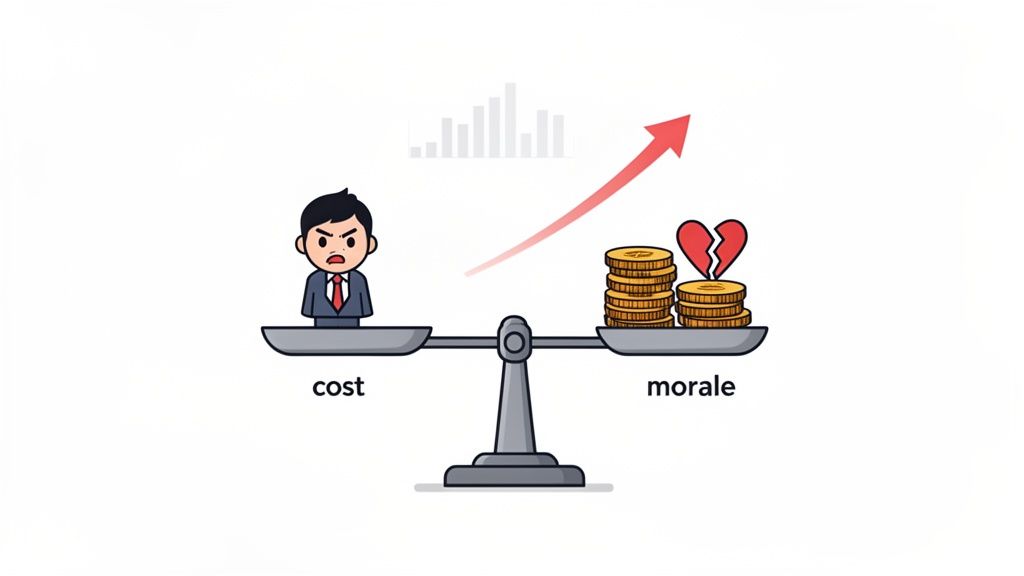
It’s easy to write off a rude interaction as “just part of the job,” but that thinking is costly. When you add up all those “one-off” incidents, you start to see a pattern that chips away at more than just an agent’s good mood. It hits your employee retention, slows down your whole operation, and ultimately, hurts your bottom line.
This isn’t just a hunch; the data backs it up. Research from Georgetown University professor Christine Porath back in 2022 showed that 76% of frontline workers were dealing with incivility at least once a month. Another 78% were witnessing it just as frequently. These aren’t small numbers, and they represent a serious spike in customer aggression.
Moving Beyond Outdated Advice
We’ve all heard the old mantra, “the customer is always right.” While the sentiment is about service, it’s a dangerously outdated idea when you’re facing genuinely abusive behavior. It puts support agents in a terrible spot, forcing them to just take the heat, which is a fast track to burnout.
When your team is constantly playing defense, a few things start to break down:
- Agent Burnout Skyrockets: Constant hostility is emotionally draining. It’s a huge reason why good people quit, and the cost to rehire and retrain someone is a massive, often hidden, expense.
- Productivity Takes a Nosedive: One nasty conversation can throw an agent off their game for hours. That emotional hangover means slower response times for everyone else in the queue.
- Service Becomes a Coin Flip: Without a clear playbook, every agent handles rudeness differently. That inconsistency looks unprofessional and just confuses customers more.
The real cost here isn’t a few tough tickets. It’s the slow-burn damage to morale, the constant churn of great employees, and the death of the consistent, quality service you’re trying to build.
The Financial Impact of Poor Interactions
Every bad interaction has a price tag, even if you don’t see it right away. The most obvious cost is churn. Investing in strategies to reduce customer churn is critical, but it all starts with how you manage these tense frontline conversations.
Today, unhappy customers don’t just leave quietly. They post on social media, leave scathing reviews, and tell their friends. One poorly handled incident can spiral into a public relations headache, turning off countless potential customers before they even talk to you.
That’s why knowing how to handle rude customers isn’t just a “soft skill” for the support team-it’s a core business competency. It’s about damage control, preserving relationships, and building a more resilient and effective support operation from the ground up.
Mastering De-escalation in Tense Conversations
When a conversation with a customer starts to get heated, that first minute is everything. Your team’s initial reaction can either pour water on the fire or turn a spark into a full-blown crisis. This is where mastering the art of de-escalation becomes a non-negotiable skill for any support pro trying to handle a rude customer effectively.
We need to move past the generic advice of “just stay calm” and arm your team with specific, proven tactics. The goal isn’t just to end the conversation; it’s to steer it toward a productive resolution, preserving both the customer relationship and your agent’s well-being.
Practice True Active Listening
Before you can solve a thing, you have to understand the real problem. That starts with listening-truly listening. Active listening is way more than just waiting for your turn to speak; it’s about making the customer feel heard and genuinely understood. Agents can dramatically improve active listening skills to better connect with and respond to a customer’s actual concerns.
This means paying close attention to not just what the customer says, but how they say it. Notice their tone, the specific words they use, and the emotion behind them. A customer who says, “I’m just so frustrated,” is handing you a direct emotional cue you need to acknowledge.
Key Takeaway: Active listening validates the customer’s feelings without necessarily agreeing with their every point. It sends a powerful message: “I am here with you, and I am trying to understand.” This simple act can lower a customer’s defenses almost immediately.
Choose Your Words Wisely
The phrases your agents use can either build a bridge or a wall. Language that shows empathy and validation proves you’re on the customer’s side, ready to work with them to find a solution. Small shifts in phrasing can make a world of difference.
Try incorporating these powerful empathetic phrases into your team’s vocabulary:
- “I can hear how frustrating this situation must be for you.”
- “That sounds incredibly difficult. Let’s see what we can do to fix this together.”
- “Thank you for bringing this to my attention. I want to make sure we get this right.”
- “You’re right to be upset. If I were in your shoes, I would feel the same way.”
These statements don’t admit fault or promise an impossible fix. Instead, they acknowledge the customer’s emotional state, which is often the first thing an angry customer needs to hear. You can learn more about preparing this kind of language in our guide on how to create canned responses for helpdesk emails, ensuring your team has consistent, effective messaging ready to go.
Scripts for High-Tension Scenarios
Having a plan for worst-case scenarios gives agents the confidence to manage even the most difficult interactions. Here are a few battle-tested ways to handle rude customers in common high-tension situations.
When a Customer is Yelling:
Instead of matching their volume, lower your own. Speak in a calm, steady voice. This contrast often forces the other person to quiet down just to hear you. You might say, “I understand your frustration, but it’s difficult for me to help you when you’re yelling. Can we work together to solve this?”
When a Customer Uses Profanity:
Address the language directly but calmly. A solid script is: “I want to help you, but I can’t continue the conversation if you use that kind of language. I’m here to find a solution.” This sets a clear, professional boundary without coming across as confrontational.
When a Customer Makes it Personal:
If a customer starts insulting an agent, it’s crucial to redirect the conversation back to the issue at hand. An effective response is: “I understand you’re upset about the situation, but personal comments aren’t productive. Let’s focus on what happened with your account so I can help resolve it.” This tactic gracefully deflects the attack and pulls the interaction back into a professional framework.
Building a Smarter Escalation Process
Not every battle should be fought by your frontline agents. Knowing when to pass the baton is a crucial skill, protecting both your team’s morale and the customer relationship. A well-defined escalation process acts as a safety net, ensuring high-stakes issues get the right eyes on them instantly.
The goal isn’t just to move a problem up the chain. It’s about creating a clear, no-nonsense path that triggers when certain lines are crossed. This removes the guesswork for your team and guarantees a consistent response, no matter who’s handling the ticket.
This decision tree shows a simple starting point for handling heated interactions, focusing on whether active listening or strategic silence is the best initial approach.
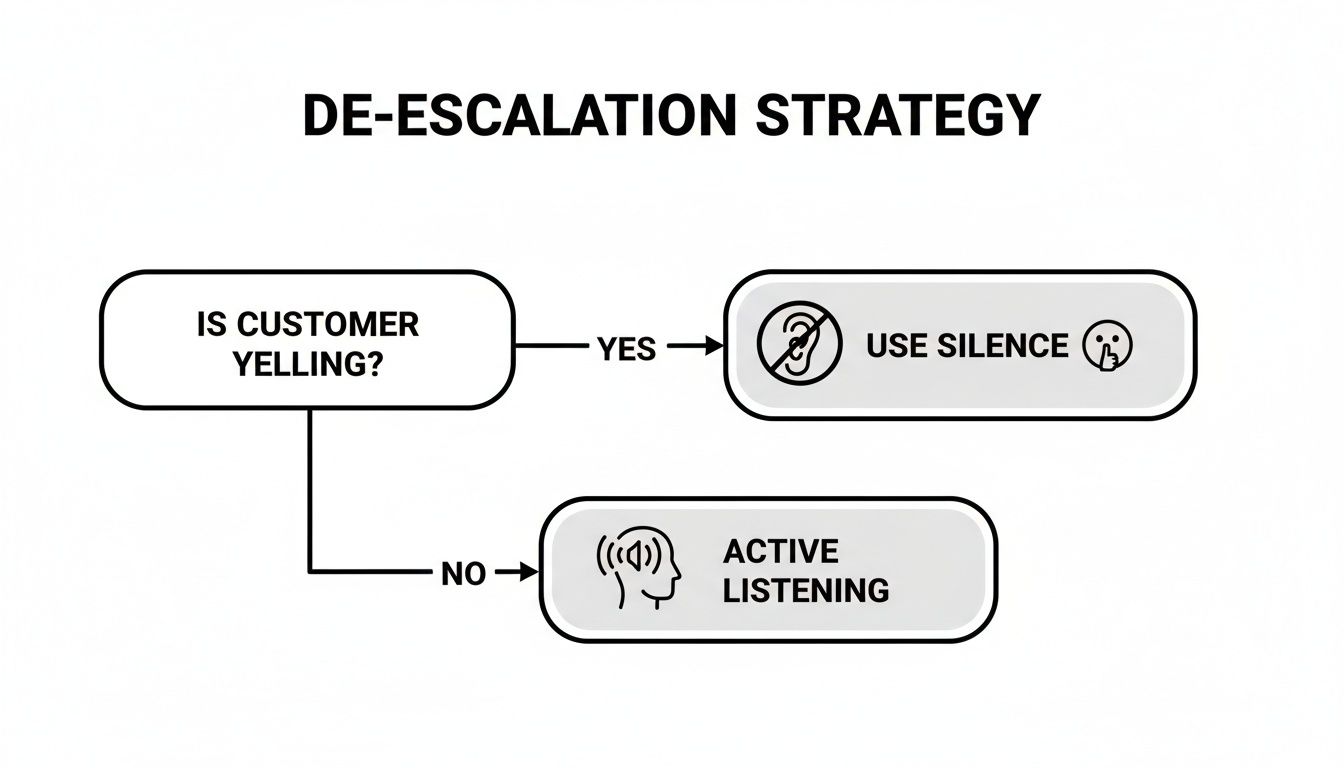
As the visual highlights, the right immediate action depends entirely on the customer’s behavior. A one-size-fits-all response just doesn’t work.
Defining Your Escalation Triggers
An effective escalation process starts with concrete, unambiguous triggers. Your agents shouldn’t have to guess when it’s time to call for backup. These should be documented in your internal knowledge base so every team member knows exactly what to do when a conversation turns south.
Here are a few common triggers to consider:
- Explicit threats or abusive language: This is a zero-tolerance area. Any interaction involving threats, discriminatory language, or severe personal insults must be escalated immediately for employee safety.
- Mention of legal action: Keywords like “lawyer,” “sue,” or “legal action” should automatically flag a ticket for review by a manager or a specialized team. Don’t leave this to chance.
- Second failed resolution attempt: If an agent has tried to resolve an issue twice and the customer is still angry, it’s time for a fresh perspective. Bring in a senior team member with more authority to find a solution.
- Request to speak to a manager: While some customers use this as a tactic, it should always be honored. A clear process ensures this handover is smooth and the manager has all the context they need to jump in.
Think of these triggers as circuit breakers. They stop a difficult situation from spiraling into a full-blown crisis.
Automating the Escalation Workflow
Instead of relying on manual handoffs, you can use modern helpdesk platforms to automate the entire process. This makes it faster, more reliable, and a whole lot less stressful for your agents. For example, a system like Ticketdesk AI can monitor tickets for specific keywords or high levels of negative sentiment.
When a ticket contains the phrase “breach of contract” or the AI detects extreme frustration in the customer’s tone, it can bypass the frontline queue entirely. The ticket is instantly rerouted to a Tier 2 support lead or a customer success manager.
This automation does more than just save time-it creates an essential buffer for your team. Agents can focus on solving problems within their scope, confident that a system is in place to catch and redirect the issues they aren’t equipped to handle.
This intelligent workflow is a core component of effective support operations. You can learn more about how automated ticket routing in practice creates a more resilient support structure. By building a smarter escalation path, you empower your agents, protect your business, and provide a better experience even for your most challenging customers.
It takes more than just one amazing agent to consistently de-escalate tough situations. If you want to build a team that can handle rude customers without missing a beat, you need to think bigger than individual talent. You need a solid foundation built on clear policies, real-world training, and the right tech.
A support environment that truly protects its agents starts by empowering them. When your team knows for a fact that management has their back, they can step into those tense conversations with a sense of calm authority, not fear.
And getting this right has never been more critical. The 2023 National Consumer Rage Survey found that U.S. companies are at risk of losing an eye-watering $887 billion in future business because of poor complaint handling. The report also revealed a shocking 63% of customers with issues felt rage, and 43% admitted to yelling at an agent-a huge leap from 35% back in 2015. You can dig into all the customer aggression trend findings in the full report.
Create an Unambiguous Internal Policy
First things first: you need a written policy that spells out exactly what is and isn’t acceptable customer behavior. This document is your team’s armor. It removes the guesswork and gives agents the green light to step away from abusive chats or calls without worrying about getting in trouble.
Your policy needs to be direct and clear on a few key things:
- Define abuse: Don’t be vague. List specific examples like profanity, personal insults, discriminatory language, or threats.
- Outline the disengagement protocol: Give your agents a clear, step-by-step script. Something simple like, “I really want to solve this for you, but I can’t continue if you’re using that language. If it happens again, I’ll have to end this chat.”
- Specify documentation steps: Tell them exactly what to do next. Use internal notes to log the incident, add a tag like “abusive_customer,” and escalate the ticket for a manager to review.
This isn’t about being punitive toward customers. It’s about protecting your people. When your team knows precisely where the line is and what action to take when it’s crossed, they can work from a place of security, not vulnerability.
Train for Reality, Not Just Theory
De-escalation and emotional resilience are muscles. They need to be trained and strengthened over time. Training shouldn’t be a one-and-done onboarding task; it needs to be a continuous part of your support strategy.
A solid training program that actually prepares your team should include:
- Role-playing difficult scenarios: Practice makes perfect. Run simulations of everything from an angry customer demanding an impossible refund to someone getting personal. This helps agents build muscle memory for using the right words and staying calm under pressure.
- Emotional self-regulation skills: It’s vital to teach your team how to manage their own stress and emotionally detach from a hostile interaction. These techniques are absolutely essential for preventing burnout.
- Practical tool training: Show agents how to use their helpdesk as a lifeline. This could be using internal notes to discreetly ping a manager for help, applying the right tags for reporting, or using AI-suggested replies to grab pre-approved, level-headed phrasing in a pinch.
Use Your Helpdesk to Build Consistency
Your technology stack can be an incredible ally in reinforcing your policies and training. A modern helpdesk like Ticketdesk AI gives you the tools to help even a brand-new agent respond with the polish of a seasoned pro.
For example, AI-suggested replies can instantly serve up empathetic, pre-vetted phrases, making sure every agent maintains a consistent and professional tone, even when they’re flustered. If an agent is really in a tough spot, they can use internal notes to flag a manager for advice without the customer having any idea.
When you bring together clear policies, ongoing training, and smart technology, you create a supportive ecosystem. The burden of dealing with a difficult customer is no longer on one person’s shoulders. It becomes a shared, manageable process, helping you build a resilient team that can handle anything that comes their way.
Using AI and Data to Prevent Customer Frustration
The best way to deal with a rude customer is to stop them from becoming one in the first place.
This means getting ahead of the problem. Instead of just reacting to angry messages, you need to actively hunt down and fix the friction points that cause frustration. Your support queue isn’t just a list of problems; it’s a goldmine of data waiting to be analyzed.
This whole strategy starts with tracking the right metrics-the ones that act as an early warning system for customer anger. By keeping a close eye on a few key numbers, you can spot trouble before it boils over into a backlog of difficult conversations.
Identifying Key Friction Points in the Customer Journey
Let’s be honest: customers don’t want to contact support. Their frustration usually builds up from small, repeated annoyances in their journey-a confusing checkout process, a buggy new feature, or unclear shipping info. Pinpointing these friction points is the first step to playing offense.
Some of the most revealing metrics are:
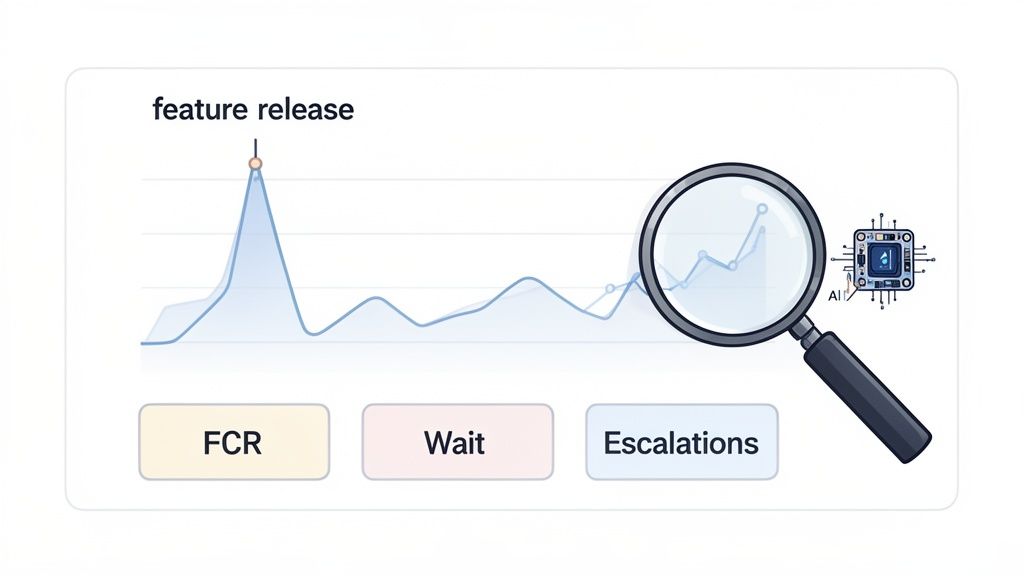
- First-Contact Resolution (FCR): A low FCR is a huge red flag. It means customers have to reach out multiple times for the same issue, which is a guaranteed recipe for frustration. It points directly to gaps in your processes or knowledge base.
- Escalation Rate: This is simply the percentage of tickets your frontline agents have to pass up the chain. If this number is high or climbing, it’s a clear sign that a new, complex problem has emerged that your team isn’t ready for.
- Average Handle Time (AHT): While you want AHT to be low, a sudden spike is telling. It often means agents are wrestling with a complicated issue, leading to longer, more aggravating interactions for everyone.
By monitoring these numbers, you transform your helpdesk from a reactive cost center into a proactive intelligence hub. A sudden surge in escalations from users of a specific feature is a clear signal to your product team that something is broken.
Using AI for Proactive Support
Modern AI-powered platforms like Ticketdesk AI are built to surface these trends automatically. Instead of drowning in spreadsheets, you get real-time dashboards showing you exactly where the friction is. The system can analyze ticket content on its own and spot patterns, like a flood of angry tickets all mentioning a recent software update.
This lets you act immediately. You can create a canned response, update your knowledge base articles, or even get the product team to roll back the update before the problem snowballs. This is one of the most powerful ways to use AI in customer service; it turns raw data into concrete actions that prevent frustration at scale.
This proactive stance is more important than ever. A 2025 Latvian survey found that a staggering 57% of service employees faced harassment from customers, from rude comments to outright threats. The data also revealed that women were affected almost twice as often as men, highlighting the very real emotional toll these interactions take. You can see more from the Venipak study on workplace harassment.
Automating the First Touchpoint
Another major trigger for customer anger is just waiting. Long queue times feel disrespectful and send the message that a company doesn’t value its customers’ time. This is another spot where AI can completely change the game.
AI-powered features can make that first interaction much smoother and faster:
- Automated Ticket Routing: The system can instantly read an incoming ticket, understand what it’s about, and send it to the right department-billing, tech support, sales-without a human ever touching it. This slashes wait times and gets the customer to the right expert on the first try.
- Instantaneous Auto-Replies: While the customer waits for a human agent, AI can provide an immediate, smart response. This isn’t your basic “we got your message” email. It can suggest relevant help articles or ask clarifying questions, making the customer feel heard from the very first second.
By using data and AI to smooth out these rough patches, you’re doing more than just boosting efficiency. You’re building a system where fewer customers have a reason to get angry, letting your team focus on delivering great service instead of just putting out fires.
Common Questions About Handling Rude Customers
Navigating customer support means you’re bound to run into situations that don’t fit the standard playbook. This is where having solid answers to tough questions becomes critical for any team learning how to handle rude customers. Let’s walk through some of the most common and tricky scenarios you’ll face.
What Is the Best Way to Respond When a Customer Uses Profanity?
When a customer starts using profanity, your immediate goal is to de-escalate without making things worse. The trick is to stay professional and avoid matching their aggressive tone.
Address the behavior calmly and directly. A phrase like, “I understand your frustration, but I can help you more effectively if we can communicate without profane language,” usually does the trick. It sets a clear boundary while keeping the focus on solving their problem.
If they keep it up, it’s time to lean on your company’s policy for abusive language. This might mean giving them a final warning before you have to end the conversation. Always use your helpdesk to document the incident with internal notes and tag the ticket appropriately so management can review it. This ensures you’re upholding a standard of respect while protecting your team.
How Can I Support My Agents’ Mental Health?
Supporting your agents’ mental health isn’t just a “nice-to-have”-it’s a necessity. Being on the receiving end of hostility all day is a fast track to burnout, and you have to be proactive to build a resilient team.
Start by creating a culture where agents feel safe talking about difficult interactions without being judged. I’ve found that regular, informal debriefing sessions where they can share what happened and vent are incredibly helpful.
Empowering agents with clear policies that allow them to escalate or disengage from abusive situations is one of the most powerful mental health supports you can provide. It tells them their well-being is a company priority.
Beyond that, provide solid training on emotional resilience and practical stress management techniques. You can also use tools to deflect the routine, often frustrating queries, which cuts down on their overall exposure to negative interactions. And finally, don’t forget to consistently recognize and reward their professionalism-it reinforces that their hard work in tough situations is seen and valued.
When Is It Appropriate to Fire a Customer?
“Firing” a customer is a big deal and should always be the absolute last resort. You only take this step after extreme and repeated instances of abusive behavior where every single de-escalation attempt has failed.
The decision usually becomes appropriate when a customer’s behavior includes:
- Credible threats of violence against an employee or the company.
- Discriminatory or harassing language that makes the work environment unsafe.
- Repeated, documented verbal abuse even after multiple warnings.
This process has to be handled by senior management and must follow a clear, documented protocol. Make sure every interaction leading up to this decision is meticulously logged in your helpdesk. This creates a clear paper trail that justifies the action, protects your team, and draws a firm line against unacceptable conduct.
Can AI Really Help in Emotionally Charged Interactions?
Absolutely. While AI is never going to replace genuine human empathy, it’s an invaluable co-pilot for your support agents, especially during tense conversations. Think of its primary role as clearing the path so your team can focus on the person, not the process.
For instance, AI-powered platforms can handle the initial contact instantly, which cuts down on the frustration from long wait times-a common trigger for anger. It can also analyze a customer’s language for negative sentiment and keywords, then automatically tag and route the ticket to a specialist or manager who is best equipped to handle it.
AI can also give agents templated, pre-approved responses and relevant knowledge base articles right when they need them. This frees up the agent to focus entirely on the emotional side of the conversation instead of scrambling for information. It’s a powerful mix of speed, consistency, and support that empowers your team to manage difficult situations far more effectively.

Ready to get started?
Join hundreds of teams using Ticketdesk AI to deliver exceptional customer support.