The Real Benefits of AI in Customer Service Explained
We’ve all been there-stuck on hold, listening to that same repetitive music, only to have to repeat our story to three different people. It’s the classic, frustrating customer support loop, a system often bogged down by too many calls, not enough staff, and rigid 9-to-5 hours. These common headaches don’t just annoy customers; they create a slow, expensive mess for businesses.
This is exactly where AI changes the game. It’s not about replacing your team but giving them superpowers. Imagine a world where simple questions get answered instantly, day or night and tricky problems land on the desk of the right expert without anyone lifting a finger.
The main wins with AI in customer service are crystal clear: dramatically lower costs, much faster response times, and the ability to give every customer a personalized experience, 24/7. This tech lets businesses break free from the old constraints, automating the boring stuff so human agents can focus on the complex issues that really matter.
Why AI Is Reshaping Customer Support
The shift to AI-powered support isn’t just a fleeting trend; it’s a fundamental change in how companies talk to their customers. By letting AI handle the endless, predictable questions, you free up your human team to build relationships and solve the unique, challenging problems that build loyalty.
The core advantages driving this shift are pretty compelling:
- Always-On Availability: AI chatbots and virtual assistants don’t sleep. They work around the clock, making sure customers in any time zone get immediate help without waiting for business hours.
- Serious Cost Reduction: Automating thousands of routine interactions brings the cost per ticket way down. A chatbot handling a password reset is massively cheaper than a salaried agent doing the same task over and over.
- Personalization at Scale: AI can look at a customer’s history in a split second to offer tailored advice and solutions. This makes every customer feel seen and understood, without any manual work from your team.
This diagram breaks down how these pieces fit together.
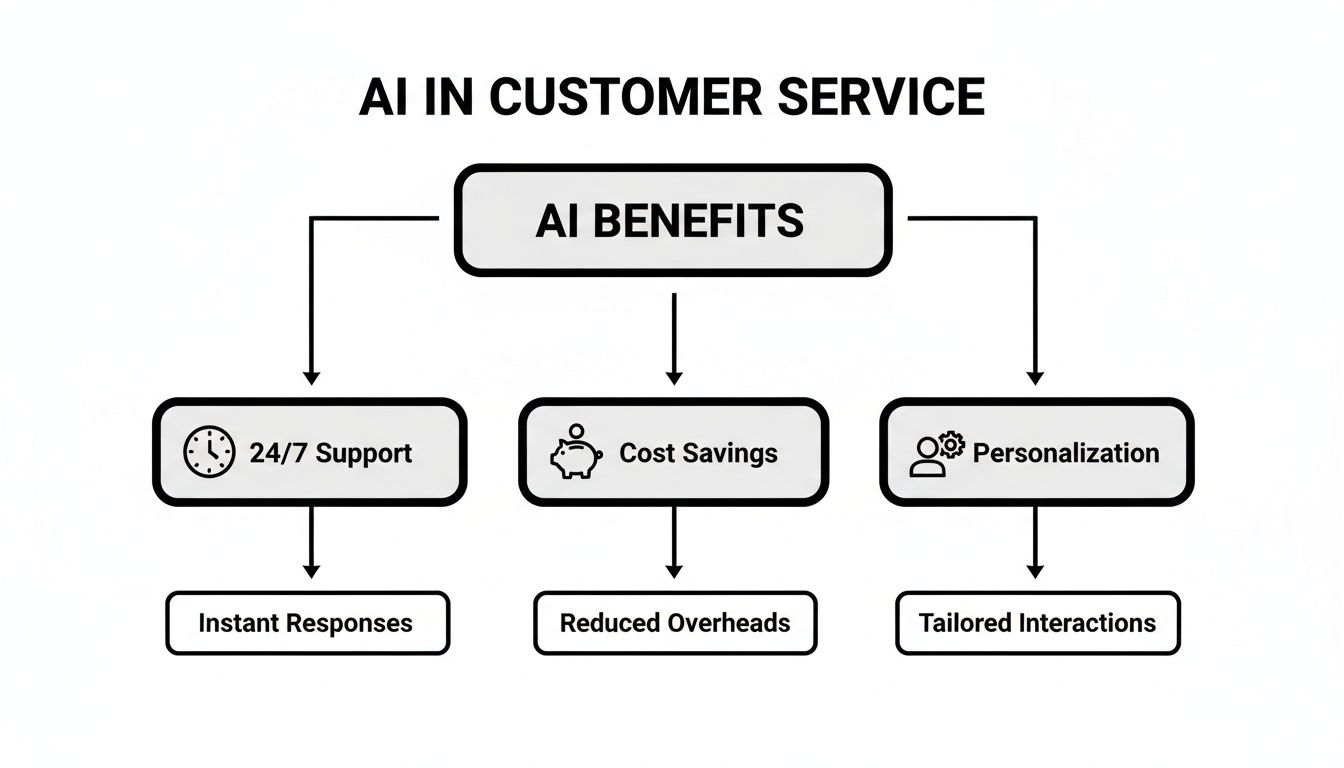
As the visual shows, these three pillars-availability, savings, and tailored experiences-are the bedrock of a modern, efficient support operation. Getting back to customers quickly is a huge part of this. You can even see how you’re doing right now with our ticket response time calculator to spot where AI could make the biggest difference.
Let’s dive deeper into each of these benefits and see how they translate into real business results.
Key Benefits of AI in Customer Service at a Glance
To really get a handle on the “why,” it helps to see the direct line between an AI feature and its impact on both your business and your customers. This table lays it all out.
| Benefit | Impact on Business Operations | Impact on Customer Experience |
|---|---|---|
| 24/7 Availability | Reduces overnight ticket backlog and eliminates the need for expensive after-hours staffing. | Customers get instant answers anytime, day or night, improving satisfaction and loyalty. |
| Faster Response Times | Drastically cuts down first response and resolution times, boosting key support metrics. | No more waiting. Customers receive immediate help for common issues, reducing frustration. |
| Cost Reduction | Automates repetitive tasks, lowering the cost per ticket and allowing for smarter budget allocation. | A more efficient system means the business can invest more in improving the overall service. |
| Personalization | Delivers tailored solutions based on user history without manual agent effort, increasing efficiency. | Customers feel understood with recommendations and solutions that are relevant to them. |
| Higher Resolution Rates | AI handles common queries flawlessly, freeing up human agents to focus on complex cases. | More problems get solved on the first try, leading to a smoother, more positive interaction. |
What this table makes clear is that the benefits aren’t just one-sided. Every improvement in operational efficiency directly translates to a better, faster, and more personal experience for the end-user. It’s a true win-win.
Driving Radical Efficiency and Cost Savings
One of the first things you’ll notice when you bring AI into your customer service is just how much more efficient everything becomes. It’s an immediate, tangible benefit.
Think of AI as a digital super-agent-one that can flawlessly handle thousands of routine questions all at once, something that’s simply impossible for a human team. This isn’t just about moving faster; it’s about completely rethinking how work gets done.
AI takes on the repetitive, time-sucking tasks that bog down your support agents. We’re talking about things like initial ticket sorting, data entry for new cases, and answering the same FAQs over and over. By offloading this work, AI acts as a genuine force multiplier for your team.
This frees up your people to focus their skills on high-value, complex customer problems-the very stuff that needs critical thinking and a human touch. Instead of getting stuck on password resets, they can spend their time saving at-risk customers or untangling tricky technical issues.
Automating the Repetitive Workload
At its heart, AI-driven efficiency is all about smart automation. An intelligent system can read a new ticket, understand what the customer needs, and take the right first step without anyone lifting a finger. This process instantly removes bottlenecks and speeds up the entire support workflow right from the start.
Here are a few common ways this plays out:
- Intelligent Ticket Routing: AI reads an email or chat and instantly sends it to the right department. A billing question goes straight to finance, while a bug report lands directly with the engineering team.
- Automatic Data Tagging: The system can apply relevant tags like “billing,” “feature request,” or “urgent” to every ticket. This makes reporting and spotting trends almost effortless.
- Instant FAQ Responses: For those common questions-“How do I track my order?” or “What are your business hours?”-an AI chatbot can pull the right answer from your knowledge base in a split second.
This level of automation means every single query gets the right attention faster than ever. It gets rid of the manual triage process that leaves customers waiting and agents staring at a disorganized queue.
The Clear Financial Impact
All these efficiency gains translate directly into serious cost savings. When you automate a high volume of simple interactions, you bring your cost-per-interaction way down. This financial upside is one of the biggest reasons businesses are bringing AI into their support operations.
The numbers speak for themselves. Recent stats show that AI implementation leads to an average 25% reduction in overall service costs. A big reason for this is that a chatbot interaction costs around $0.50, while a human-led one can run you $6.00-that’s a twelve-fold difference that adds up fast. Some projections even suggest that AI will drive $80 billion in global contact center labor cost savings by 2026, just by handling these routine tasks.
By reducing the need for a human to touch every single ticket, AI allows you to scale up your support capacity without having to scale up your headcount at the same rate. Your existing team can handle a much higher volume of inquiries, boosting productivity and protecting your bottom line.
This isn’t just about cutting expenses. It’s about getting more out of the investment you’ve already made in your team. Every dollar saved on repetitive tasks can be put back into training, better tools, or growing other parts of the business.
Curious about what this could look like for you? You can see the potential savings for your own team by using our help desk ROI calculator to model the financial benefits.
Ultimately, the goal is a leaner, more effective support system where technology handles the volume and humans provide the value. This strategic blend is the key to unlocking radical efficiency and sustainable cost savings in modern customer service.
Crafting Hyper-Personalized Customer Journeys
Let’s be honest, the days of “Dear Valued Customer” are long gone. Today’s customers expect you to know them-who they are, what they’ve bought, and what they need help with right now. This is where AI completely flips the script, turning customer service from a reactive chore into a proactive, personal concierge for every single user.
AI gives businesses the power to deliver these deeply personal experiences at a scale that was simply impossible before. It’s like having a brilliant data detective on your team, one who can instantly piece together a complete picture of each customer from mountains of information.
And we’re not just talking about using a customer’s first name in an email. AI dives much deeper, looking at everything from past purchases and old support tickets to what they’re doing on your website in real-time. It figures out their specific needs and what they’re trying to do, which lets you tailor every single interaction.
Moving Beyond Basic Data Points
Real personalization is all about context. A smart AI system doesn’t just see a customer; it sees their entire journey. It connects the dots between that product they bought last month, the help article they skimmed yesterday, and the question they’re asking today.
This deep level of understanding makes for incredibly relevant and helpful conversations. Instead of forcing a customer to repeat their entire life story, the AI already knows it, creating a smooth, frustration-free experience from the get-go.
Think about this: according to McKinsey, a staggering 71% of consumers now expect and even demand personalized interactions. If you’re not delivering that, you’re not just missing an opportunity-you’re actively pushing customers away.
Personalization isn’t a “nice-to-have” anymore. It’s a fundamental expectation that directly impacts customer loyalty and, ultimately, your bottom line.
How AI Creates These Tailored Experiences
So, how does this actually play out in the real world? It’s less sci-fi and more practical than you might think. This is where AI truly shows its value in customer service.
Here are a few concrete examples:
- Proactive E-commerce Help: A customer just bought a new camera from your online store. Instead of a generic “How can I help?” an AI chatbot pops up with, “I see you just got the new camera! Here’s a link to the quick-start guide and a suggestion for a compatible memory card that’s on sale.”
- Targeted SaaS Onboarding: A new user is clicking around an advanced reporting feature in your software but seems stuck. Before they can even think about filing a support ticket, the AI triggers a pop-up with a short video tutorial for that exact feature.
- Customized Travel Ideas: Someone is chatting with a travel bot about a trip to Italy. By looking at their past bookings (which were all beach vacations at boutique hotels), the AI suggests a charming coastal town with unique inns instead of just listing big-city hotels. The recommendation feels personal and insightful.
In every case, the AI isn’t just answering a question-it’s anticipating a need. It uses data to make every customer feel seen, understood, and genuinely valued.
The Long-Term Payoff
This kind of hyper-personalization does more than solve an immediate problem. It builds a real, lasting connection between the customer and your brand.
When interactions are consistently helpful and relevant, people stick around. They’re more likely to come back, spend more over their lifetime, and tell their friends about you. By making every customer journey feel unique, AI turns routine support chats into memorable experiences that drive real business growth.
Providing Always-On Support and Instant Answers

Your customers don’t stick to a nine-to-five schedule, so why should your support? When a question pops up at 10 PM on a Saturday, making someone wait until Monday morning feels like an eternity in today’s world. This is where AI completely changes the game with one of its biggest benefits: always-on support.
Let’s face it, traditional support teams are bound by the clock. Time zones, business hours, and holidays create unavoidable delays and frustrating ticket backlogs. AI-powered tools, like chatbots and virtual assistants, run 24/7/365 and never need a coffee break. This means your business is always open and ready to help anyone, anywhere, at any time.
It’s a fundamental shift. You’re replacing the dreaded “we’re currently closed” message with instant, helpful engagement, which is exactly what modern customers expect.
Meeting the Demand for Instant Gratification
In a world of one-click checkouts and on-demand everything, patience has become a pretty scarce resource. Customers don’t just prefer fast answers anymore-they flat-out expect them. In fact, research shows that 51% of customers now expect businesses to be available around the clock. That’s a massive expectation gap that old-school support models just can’t fill.
AI closes this gap by delivering immediate answers to a huge volume of common questions. Think about all the simple, yet urgent, things people ask outside of business hours:
- “Where’s my order?”
- “How do I reset my password?”
- “Can you remind me of your return policy?”
An AI assistant can tackle these in seconds, stopping a minor hiccup from turning into a major frustration. This ability to resolve issues instantly is a massive win for customer satisfaction.
When you make support accessible the exact moment a customer needs it, you’re removing friction from their experience. This immediate help doesn’t just solve their problem; it builds real confidence and loyalty in your brand.
Boosting First-Contact Resolution Rates
One of the most important benefits of AI in customer service is its impact on first-contact resolution (FCR). This metric is simple: how often do you solve a customer’s issue in the very first interaction, with no follow-ups or escalations needed? A high FCR is the hallmark of an efficient support team.
Because an AI has instant access to your entire knowledge base, it can give accurate, consistent answers to straightforward questions every single time. It never has an “off day” or forgets a key detail. This consistency is crucial for solving common problems right away, on the first try.
For example, an e-commerce customer struggling with a discount code at midnight can get step-by-step instructions from a bot and complete their purchase, instead of just giving up. Or a SaaS user locked out of their account on a Sunday can get back in immediately. These are perfect, real-world examples of AI driving up FCR by simply always being there.
This has a powerful ripple effect. Higher FCR means fewer tickets land in your human agents’ queue, freeing them up to focus on the complex, high-touch issues where their expertise truly shines. The end result is a faster, smarter, and more effective support operation all around.
Uncover What Customers Really Think with AI Analytics
Beyond just closing tickets faster, AI can turn your entire customer service operation into a goldmine of business intelligence. Think about it: every single conversation, support ticket, and chatbot interaction is a breadcrumb. AI is the only tool that can follow that trail at scale and show you the bigger picture of what your customers are actually thinking and feeling.
Imagine trying to manually read and categorize thousands of customer chats every week. It’s just not possible. You’d only ever see a tiny, anecdotal slice of the pie. AI, on the other hand, chews through this mountain of unstructured data in near real-time, giving you a direct line to the collective voice of your customers.
This is how you spot the hidden trends, the recurring frustrations, and the subtle shifts in what people want-things that would otherwise fly completely under the radar. It’s a total game-changer for making smarter business decisions.
From Raw Data to Smart Moves
The real magic of AI analytics is how it turns messy, raw conversation data into clear, actionable insights. Instead of guessing why churn is up or why nobody’s using that new feature, you get answers straight from the source. This is easily one of the most strategic benefits of AI in customer service.
AI systems can automatically tag and categorize conversations based on very specific topics, which lets you spot emerging problems almost instantly. For example, the system might notice a sudden spike in chats that mention “checkout error” or “confusing dashboard.”
Here’s how that translates into real business value:
- Catch Bugs Before They Spread: A new software update goes live. Within hours, the AI flags a 15% increase in tickets mentioning “login problems.” Your engineering team can jump on the bug right away, long before it blows up into a full-blown crisis.
- Get Honest Product Feedback: The AI picks up on a recurring theme of customers asking how to export reports. This is a clear signal to your product team to prioritize building a more intuitive export feature.
- Find Holes in Your Knowledge Base: If dozens of customers are asking the same exact question about your return policy, the AI can flag this. Now you know you need a clearer, more visible help center article on that topic.
This analytical firepower shifts your support team from being purely reactive (just putting out fires) to proactively driving improvements across the whole company.
Turn Your Support Team into a Growth Engine
When you use AI to truly listen to your customers at scale, your support team stops being just a cost center. It becomes a vital source of business growth. The insights you gather from these conversations can directly inform and improve what other departments are working on.
By analyzing the sentiment and intent behind customer interactions, AI creates a continuous feedback loop. This loop helps you refine everything from your marketing messages to your product roadmap, making sure your decisions are grounded in what customers actually need-not just what you think they need.
For instance, the marketing team can learn which features customers are most excited about and build a new campaign around them. The product team gets raw, unfiltered feedback on what’s working and what isn’t, which helps them build a better product that people genuinely want to use.
Ultimately, this data-driven approach builds a more customer-centric culture throughout your entire organization. By unlocking the valuable insights hidden in your support conversations, AI puts the voice of the customer right at the heart of every strategic decision you make.
Putting AI Customer Service Benefits into Practice

It’s one thing to talk about the benefits of AI in customer service, but it’s another thing entirely to see them actually work. The real magic happens when you move from buzzwords like “efficiency” to tangible results your team can feel. This is where a solid platform becomes your secret weapon, pulling all these advantages together under one roof.
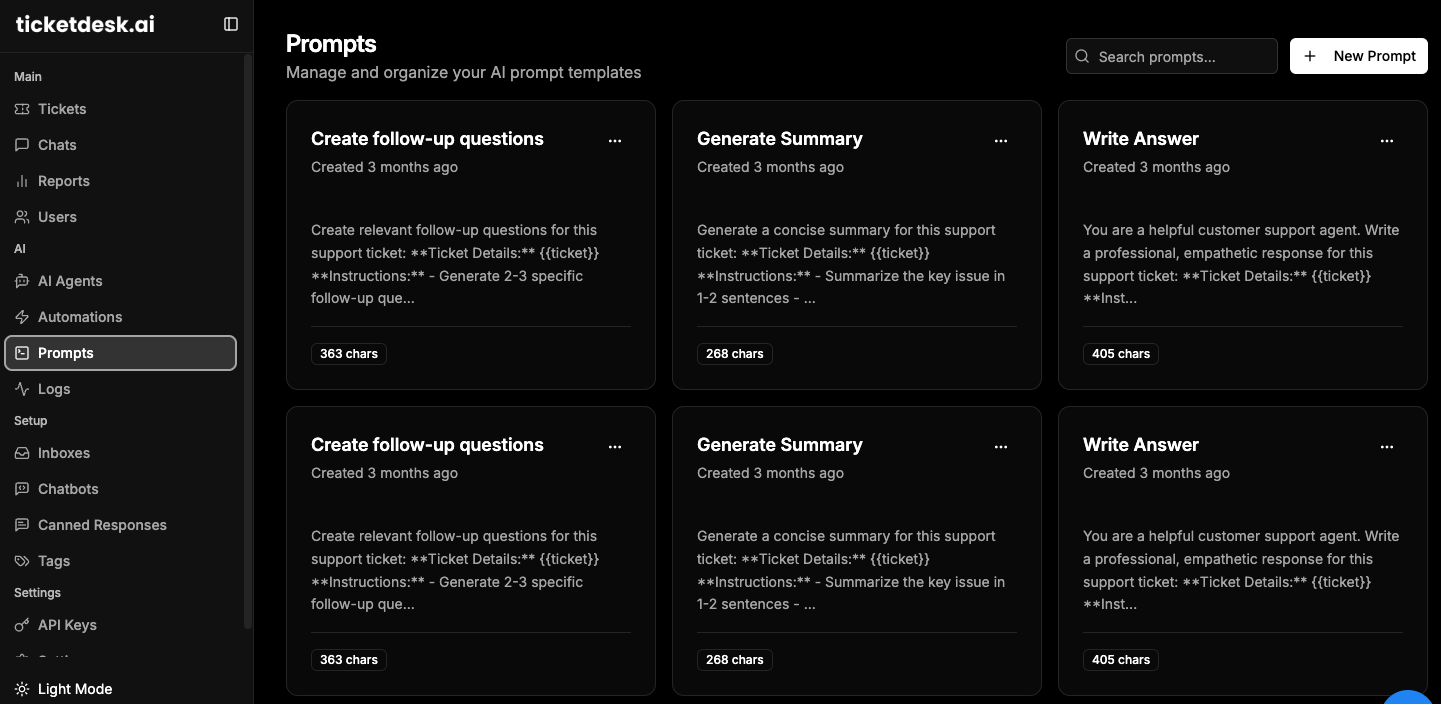
Take a platform like Ticketdesk AI, for instance. It’s built from the ground up to make these benefits practical. It doesn’t just theorize about AI; it connects every core advantage to specific, usable features that start working for you right away.
So instead of just dreaming about 24/7 support, you can actually build and deploy an intelligent chatbot that learns from your help docs. This isn’t just a gimmick-it’s a direct line to happier customers and a smaller ticket backlog for your team when they clock in.
Connecting Features to Real-World Outcomes
The best AI strategies don’t just sprinkle technology around; they use it to solve specific problems. It’s all about drawing a straight line from a tool to a number you care about, like a higher CSAT score or a lower cost-per-ticket.
Here’s how a dedicated platform turns potential into pure performance:
- For 24/7 Availability: You get an AI-powered chatbot that handles the common “how-to” and “where-is” questions instantly, no matter the time of day. This crushes your first-response time metric and keeps customers happy across every time zone.
- For Deeper Insights: An analytics dashboard crunches the numbers from thousands of conversations without you lifting a finger. It can spot a recurring bug in your latest software update, letting you get ahead of the problem before it snowballs.
- For Smarter Escalations: An intelligent routing system acts like a super-powered receptionist. It reads an incoming ticket, understands it’s a billing question, and sends it straight to finance, while a tricky technical query goes directly to a senior engineer. No more manual sorting.
When you put these tools into play, you’re not just “doing AI.” You’re building a support operation that’s more resilient, responsive, and a heck of a lot smarter. You can check out a full list of these tools and learn more about the Ticketdesk AI features that make it all happen.
The goal is simple: let AI handle the repetitive, high-volume stuff. This frees up your human agents to do what they do best-solve the complex, nuanced problems that build real customer loyalty.
Achieving Measurable Business Impact
At the end of the day, bringing AI into your workflow is about seeing real, measurable improvements. Platforms designed for customer service give you the dashboards and reports to track these results, prove your ROI, and figure out what to do next.
A dashboard like the one below gives you a real-time pulse on your support metrics.
By translating abstract benefits into practical tools and clear metrics, a platform like Ticketdesk AI gives any business a straightforward path to an effective AI support strategy. You get to see the tangible results, not just hear about the possibilities.
Frequently Asked Questions About AI in Customer Service
Let’s be honest, bringing AI into your customer support workflow raises some big questions. It’s a significant shift, and it’s completely normal to wonder about implementation, costs, and what this all means for your human agents. Getting a handle on these common concerns is the first step to building a smart strategy that actually works.
One of the first questions I always hear is, “Is this AI going to replace my team?” The answer is a hard no. The goal isn’t to replace people; it’s to make them better. AI is fantastic at chewing through the high-volume, repetitive stuff. This frees up your human agents to do what they do best: handle the complex, emotionally charged issues where real empathy and critical thinking make all the difference.
Will AI Make Our Support Impersonal?
The fear of losing that “human touch” is a real and valid concern. But here’s the thing-modern AI can actually make your support more personal, not less.
By instantly pulling up a customer’s history and behavior, AI gives your agents the full picture right away. They have the context they need to deliver solutions that are genuinely tailored and relevant. It feels more personal because the agent isn’t starting from scratch every single time.
The secret to a successful AI strategy is blending automation with human oversight. Let the AI handle the predictable, everyday questions, while your team delivers the high-value, relationship-building support that turns customers into fans. You truly get the best of both worlds.
How Hard Is This to Set Up?
People also worry about the cost and complexity of getting started. Years ago, this was a massive barrier, but today’s platforms are built for real businesses, not just giant tech companies.
Many AI helpdesk solutions, like Ticketdesk AI, are designed to be up and running quickly, often without needing a dedicated team of developers. This makes the technology accessible even for smaller teams that don’t have a massive IT budget.
For teams planning their first AI integration, a structured approach helps. Here’s a simple checklist to guide you through the key phases of implementation.
AI Implementation Checklist
| Phase | Key Action | Consideration |
|---|---|---|
| 1. Discovery & Planning | Identify high-volume, repetitive tasks. | Where is your team spending the most time on simple queries? |
| 2. Data Preparation | Gather and organize your knowledge base. | Is your documentation, FAQ, and help content up-to-date? |
| 3. Platform Selection | Choose an AI tool that fits your workflow. | Does it integrate with your existing systems (email, chat)? |
| 4. Agent Training | Train the AI on your specific data. | The better the training data, the more accurate the AI. |
| 5. Pilot & Testing | Run a small-scale test with internal users. | Does the AI respond correctly? Is escalation working? |
| 6. Go-Live & Monitoring | Deploy the AI and track performance metrics. | Keep an eye on resolution rates, costs, and customer feedback. |
This checklist isn’t exhaustive, but it covers the core steps to ensure a smooth and successful rollout. Starting with a clear plan makes all the difference.
How Do We Measure The ROI?
Measuring the return on your investment is non-negotiable. You can do this by tracking a few specific, easy-to-measure metrics that AI directly impacts.
- Cost Per Interaction: First, figure out how much it costs you to resolve a single ticket. AI brings this number way down by handling a huge volume of tickets automatically for a tiny fraction of the cost.
- First-Contact Resolution (FCR): Keep an eye on the percentage of issues you solve in the very first interaction. AI gives this a major boost by providing instant, accurate answers to all the common questions.
- Agent Productivity: Look at the number of complex tickets each of your agents can handle per day. As AI filters out all the easy stuff, this number should go up dramatically.
When you focus on these metrics, the value becomes crystal clear. The data will show you exactly how AI is making your support faster, cheaper, and better for your customers.

Ready to get started?
Join hundreds of teams using Ticketdesk AI to deliver exceptional customer support.