Best Customer Retention Software Platforms for 2026
In today’s competitive market, acquiring new customers costs significantly more than keeping existing ones. Yet, many businesses focus their resources on top-of-funnel activities, overlooking the immense value locked within their current customer base. The right customer retention software transforms this dynamic, shifting your strategy from reactive problem-solving to proactive value delivery. This guide moves beyond generic feature lists to provide a detailed analysis of the top 12 platforms designed to help you predict churn, automate engagement, and build lasting customer loyalty.
This resource is built for customer success managers, helpdesk leaders, and operations teams who need to make an informed decision without wading through marketing jargon. We dive deep into each tool, providing screenshots and direct links to help you evaluate your options efficiently. You will find practical, real-world analysis covering:
- Key Features: From churn prediction and health scoring to automated outreach and integrations.
- Pros and Cons: An honest assessment of each platform’s strengths and limitations.
- Best-Fit Use Cases: Clear guidance on whether a tool is ideal for SaaS, e-commerce, or enterprise needs.
- Integration Checklists: A look at how each solution connects with core helpdesk platforms like Ticketdesk AI.
To truly unlock growth through customer retention, businesses must focus on robust strategies to improve customer engagement, fostering stronger relationships. The software in this list provides the technological foundation for executing those strategies at scale. Our goal is to equip you with the detailed information needed to select the best customer retention software that not only solves your immediate challenges but also supports your long-term growth. Let’s explore the platforms that can turn your existing customers into your most powerful growth engine.
1. Ticketdesk AI
Best for: Businesses seeking to automate support while retaining human oversight.

Ticketdesk AI stands out as a powerful solution in the customer retention software landscape by focusing on the core of customer satisfaction: fast, accurate, and consistent support. It’s an AI-powered helpdesk that automates the most time-consuming aspects of ticket management, from smart routing and tagging to generating context-aware replies. This frees up human agents to handle complex, high-value interactions that are crucial for building long-term customer loyalty.
The platform’s key strength lies in its ability to combine intelligent automation with essential human collaboration. Instead of fully replacing agents, it acts as a force multiplier. It learns directly from your knowledge base, FAQs, and API documentation to provide instant, relevant answers 24/7. This dramatically reduces first-response times and ensures customers receive help immediately, a critical factor in preventing churn.
Key Features and Analysis
Ticketdesk AI’s feature set is engineered for efficiency and quality control. The system automatically routes tickets to the correct department (e.g., billing, engineering, product) and drafts replies, which agents can then review, edit, and approve. This hybrid model ensures brand tone and accuracy are maintained while achieving up to a 90% faster response time.
- Intelligent Automation: The AI handles ticket routing, tagging, and reply generation, reducing manual agent workload and resolution times.
- Knowledge Base Integration: It continuously learns from your documentation to provide accurate, context-specific answers without constant manual training.
- Human-in-the-Loop Collaboration: Agents can add internal notes, assign tickets, and approve AI-suggested responses, maintaining full control over support quality.
- Real-Time Analytics: Dashboards provide immediate insights into performance metrics like average response time, resolution rates, and CSAT scores. This data is vital for any proactive customer retention strategy.
Implementation and Use Cases
One of Ticketdesk AI’s most significant advantages is its rapid implementation. The platform is designed to be set up in minutes, not weeks, connecting to your existing knowledge sources to begin automating support almost instantly. Its new API also allows for deeper integrations into your existing tech stack.
For SaaS and e-commerce companies, this means providing scalable 24/7 support without a massive headcount, directly impacting user satisfaction and retention. Enterprises benefit from its security resources and the ability to streamline complex internal and external support workflows, as demonstrated by customers like Revolut and Relativity.
Pros and Cons
| Pros | Cons |
|---|---|
 Drastically reduces response and resolution times Drastically reduces response and resolution times |
 No transparent, tiered pricing on the website No transparent, tiered pricing on the website |
|
Preserves human oversight for quality control |
AI effectiveness depends heavily on your documentation quality |
|
Fast implementation and easy integration |
Human review is still necessary for sensitive cases |
|
Strong social proof from enterprise clients |
Pricing
Ticketdesk AI does not publish detailed pricing tiers. Instead, it offers a free trial and personalized demos to showcase its value proposition. The company emphasizes a significant ROI, with some case studies citing operational cost reductions from $40,000 per month to just $2,000.
For a deeper look into its capabilities, explore this practical guide to AI in customer service.
Website: https://ticketdesk.ai
2. Gainsight
Gainsight is an enterprise-grade customer success platform designed to provide a comprehensive, 360-degree view of the customer. It’s a powerful piece of customer retention software for B2B SaaS and subscription-based businesses that need to manage complex relationships at scale, moving beyond simple support interactions to proactively manage customer health and drive expansion. The platform excels at unifying data from various sources like your CRM, helpdesk, and product usage tools into a single, actionable dashboard.
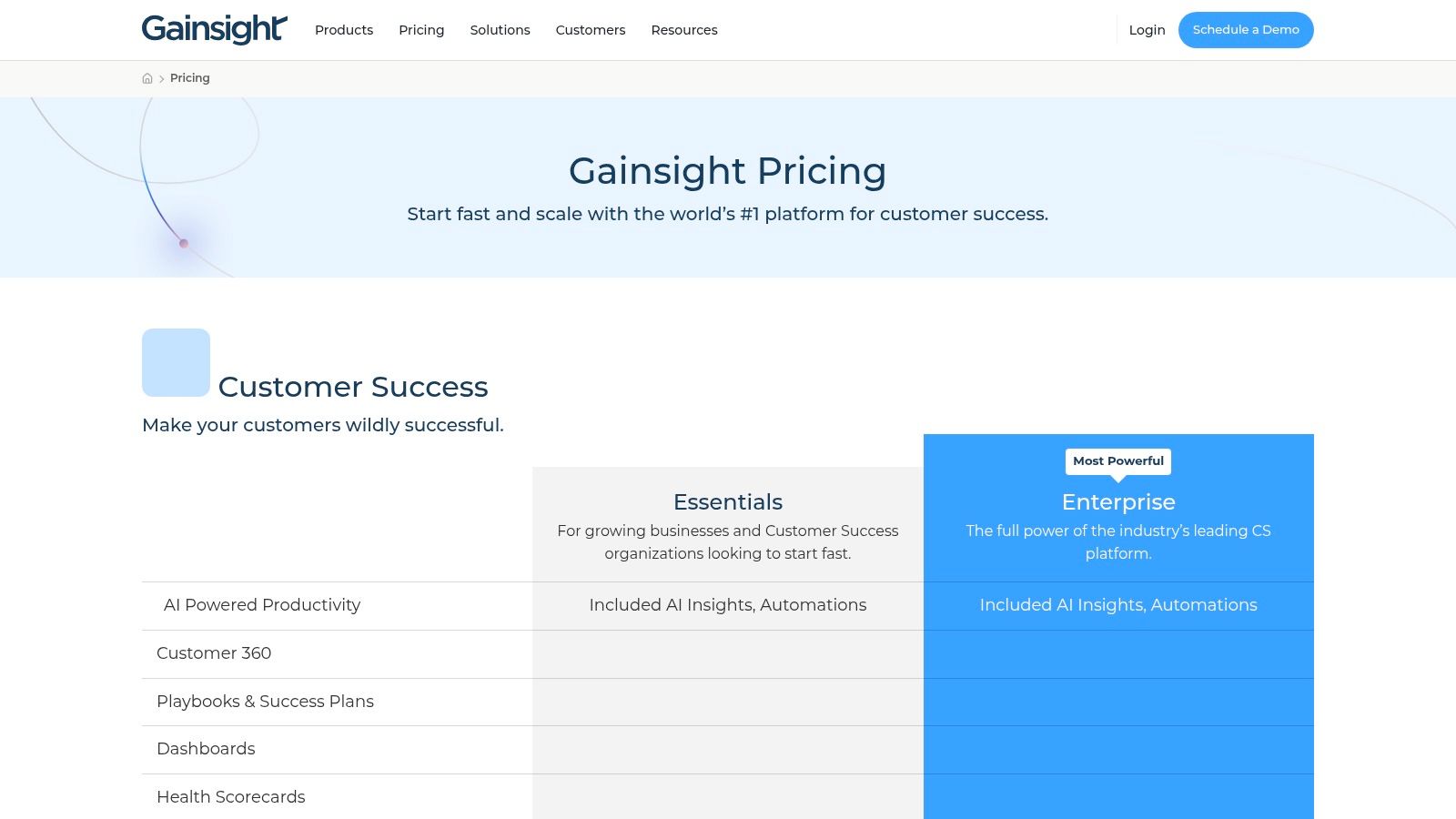
What truly sets Gainsight apart is its “Playbook” feature, which allows teams to standardize responses to specific customer health signals. For instance, if a customer’s product usage drops by 20%, a pre-defined playbook can automatically assign tasks to the Customer Success Manager (CSM), trigger an educational email sequence, and schedule a check-in. This operationalizes customer success, ensuring consistent and timely interventions. By tracking these activities, you can more accurately measure their impact on metrics like customer satisfaction; you can calculate your current customer satisfaction score here to set a baseline.
Key Features & Analysis
- Customer 360 & Health Scoring: Aggregates data into a comprehensive profile with customizable health scores, giving CSMs an at-a-glance understanding of account risk and opportunity.
- Automated Playbooks: Enables teams to build and trigger automated workflows based on customer data, such as NPS scores, support tickets, or product adoption milestones.
- Renewal & Expansion Forecasting: Utilizes customer health and engagement data to provide more accurate revenue forecasts for renewals and upsell opportunities.
- Gainsight PX Integration: An add-on for product experience analytics, allowing you to track in-app user behavior and tie it directly back to customer health scores.
Pros:
- Deeply Specialized: Purpose-built for the complex needs of enterprise and mid-market customer success teams.
- Scalable: The platform is designed to grow with your business, supporting large teams and extensive customer bases.
- Holistic Ecosystem: Unifies customer success, product experience, and customer education into one ecosystem.
Cons:
- Opaque Pricing: Requires a sales-led discovery process; pricing is not publicly available on their website.
- High Implementation Effort: Can be complex and resource-intensive to set up, often requiring dedicated internal resources or professional services.
Gainsight is best suited for established SaaS companies that are ready to invest significantly in a dedicated customer success platform to reduce churn and drive net revenue retention.
3. ChurnZero
ChurnZero is a powerful customer success platform designed from the ground up to help subscription businesses fight customer churn. As a dedicated piece of customer retention software, it integrates data from your CRM, support desk, and product usage analytics to give you a real-time, comprehensive view of your customers. The platform is built to help Customer Success Managers (CSMs) understand customer behavior, assess health, and communicate with them effectively and at scale.
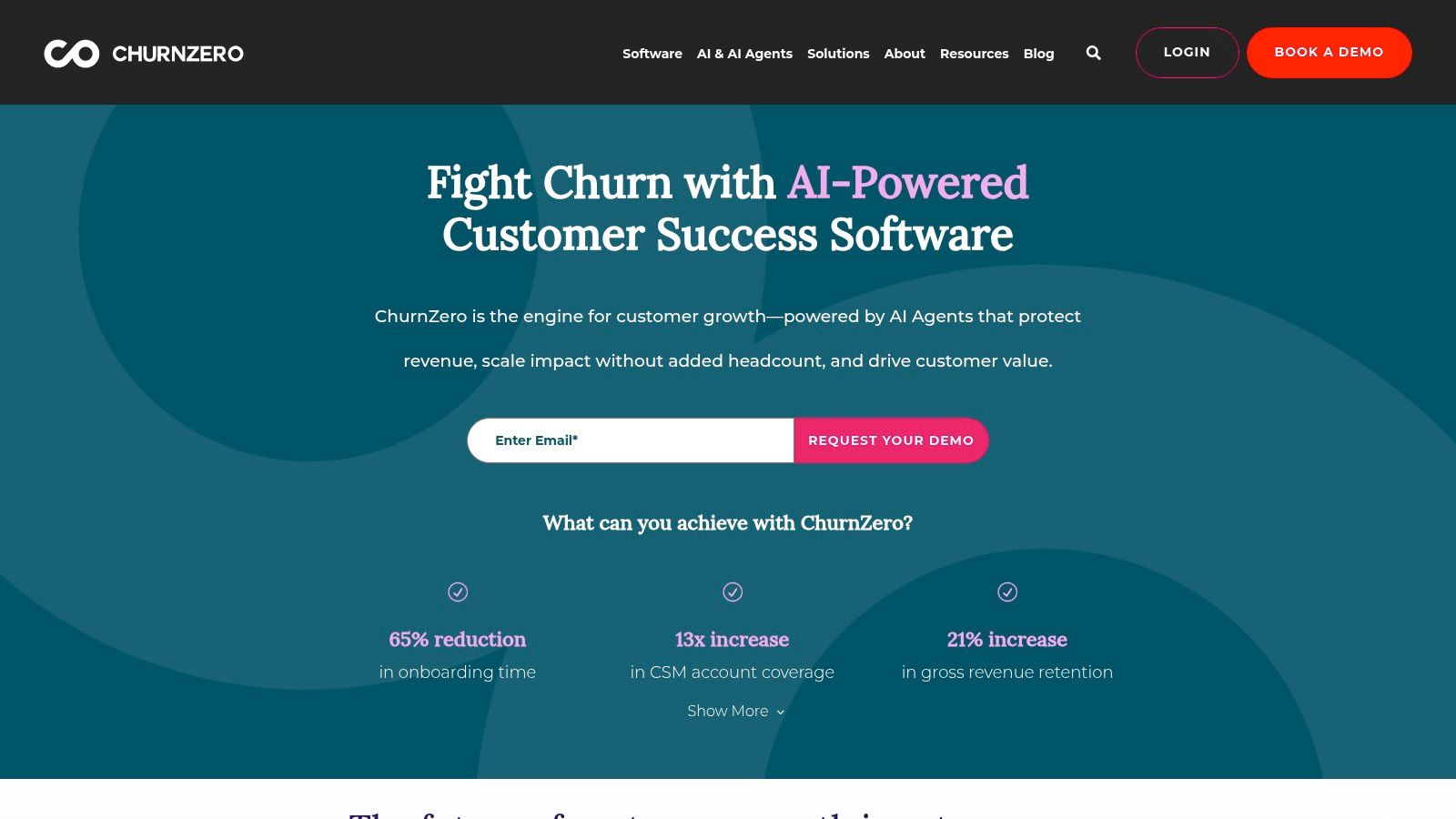
What makes ChurnZero stand out is its emphasis on operationalizing customer success through automation and proactive engagement. Its “Plays” feature allows teams to automate workflows and standardize responses to customer events, like a dip in feature adoption or a low satisfaction survey score. The platform also offers robust in-app communication tools, including guides and surveys, enabling CSMs to engage customers directly within the product context, which is crucial for driving adoption and heading off potential issues before they escalate.
Key Features & Analysis
- Customer Health Scoring: Creates dynamic and customizable health scores based on a wide range of data points, providing an instant indicator of account risk or opportunity.
- Automated Plays & Journeys: Allows for the creation of automated, multi-step workflows triggered by customer behavior, lifecycle stage, or health score changes.
- In-App Communications: Enables teams to launch targeted in-app messages, walkthroughs, and NPS surveys without requiring engineering resources.
- Renewal & Forecasting Dashboards: Provides dedicated command centers for managing upcoming renewals, tracking revenue forecasts, and identifying expansion opportunities.
Pros:
- CS-First Design: The platform is intuitively designed around the daily workflows of a CSM, making it highly practical and user-friendly.
- Strong Automation: Excels at automating routine tasks and standardizing engagement, freeing up CSMs for more strategic work.
- Excellent Customer Support: Widely recognized for its hands-on customer enablement, training, and ongoing support.
Cons:
- Quote-Based Pricing: Pricing is not publicly listed and depends on the number of accounts, users, and any add-on features.
- Can Be Overwhelming for Startups: The depth of features may be more than what a very small or early-stage team requires.
ChurnZero is an excellent choice for B2B SaaS businesses looking for a robust, user-friendly platform to scale their customer success operations and proactively reduce churn.
4. Totango
Totango stands out with its “composable” customer success platform, allowing businesses to assemble the exact tools they need rather than adopting a monolithic system. This approach makes it a flexible piece of customer retention software that scales from startups to large enterprises. At its core is a Customer Intelligence Engine that unifies data to predict churn, identify expansion opportunities, and track key moments in the customer journey, enabling teams to proactively manage account health.
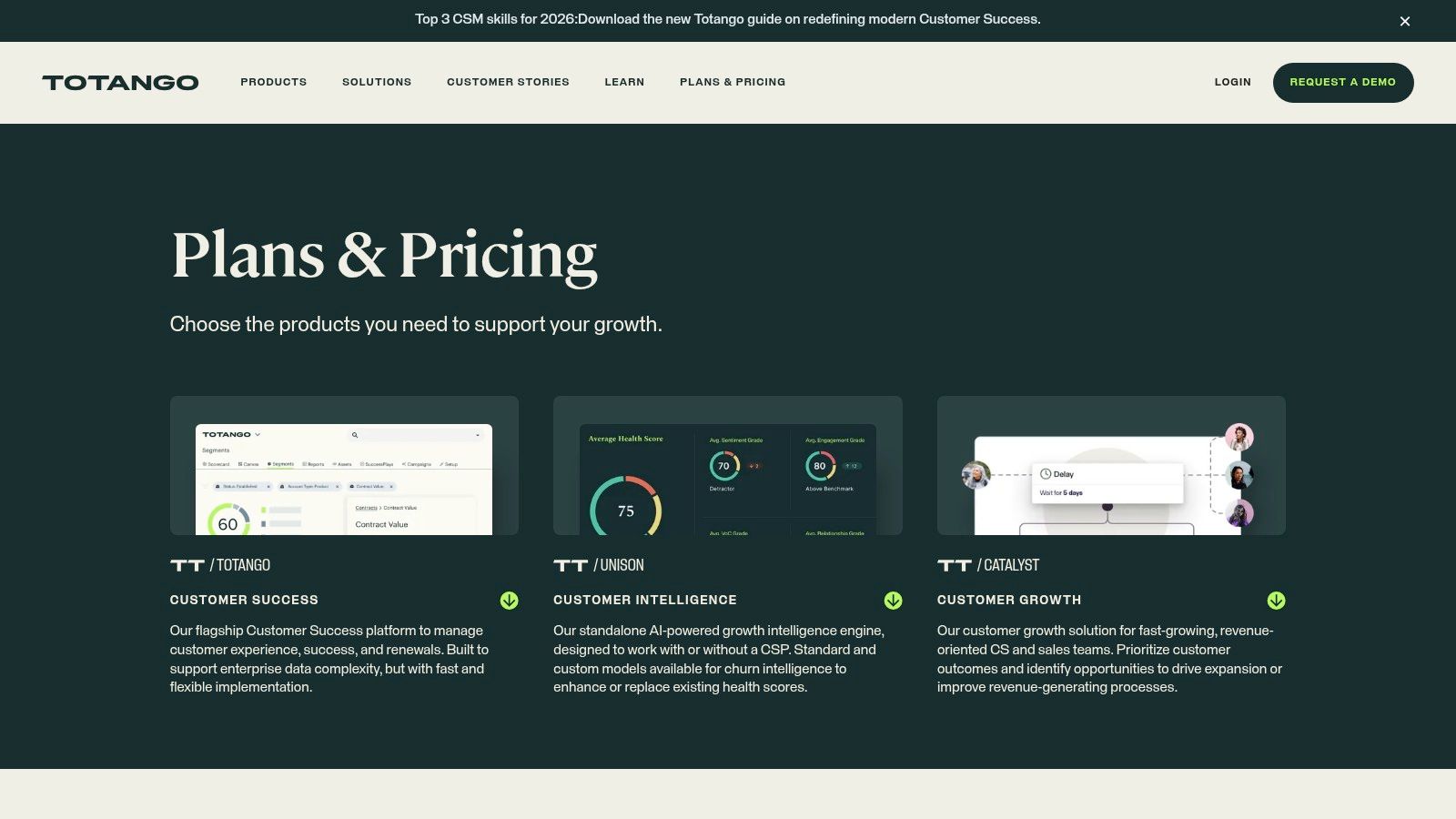
What makes Totango unique is its modular packaging, which caters to different stages of business maturity. Companies can start with a foundational package and add more advanced capabilities like AI-driven risk detection or in-depth journey orchestration as they grow. This “build-your-own-platform” philosophy prevents smaller teams from being overwhelmed by features they don’t need, while still providing the depth required for complex, enterprise-level customer management.
Key Features & Analysis
- AI-Powered Risk Detection: Utilizes machine learning to identify at-risk accounts by analyzing patterns in usage data, support tickets, and engagement metrics.
- Playbook Designer: A visual workflow builder that allows teams to create and automate “SuccessPlays” triggered by specific customer signals, such as a drop in health score or a positive NPS survey.
- Account Tiers & Segmentation: Provides robust tools for segmenting customers based on value, lifecycle stage, or custom attributes, enabling targeted and prioritized engagement.
- Composable Packaging: Offers distinct packages (Unison, Catalyst, CS) designed for different maturity levels, from foundational customer success to advanced enterprise operations.
Pros:
- Highly Scalable: The modular design supports businesses of all sizes, from fast-growing startups to large enterprises with complex account structures.
- Flexible Offerings: Segmented packages ensure companies only pay for the functionality they need, making it more accessible.
- Strong on Automation: The Playbook designer and AI features are excellent for operationalizing customer success at scale.
Cons:
- Sales-Led Pricing: Pricing is not publicly available and requires engaging with the sales team, which can be a barrier for initial evaluation.
- Can Be Costly: While flexible, the cost for advanced tiers can be a significant investment, potentially sensitive for smaller teams.
Totango is ideal for businesses that want a powerful, data-driven customer success platform that can evolve with them as their needs and operational maturity change.
5. HubSpot Service Hub
HubSpot Service Hub is a customer service suite built directly on the HubSpot CRM platform, designed to unify support, marketing, and sales data. This makes it a powerful piece of customer retention software for businesses already invested in the HubSpot ecosystem or those seeking an all-in-one solution. It connects every customer interaction, from support tickets to survey responses, directly to the customer’s lifecycle data, providing a holistic view of their journey and satisfaction.
What sets Service Hub apart is its seamless CRM integration and user-friendly automation. Teams can create workflows that trigger retention-focused actions based on service interactions. For example, a low CSAT score can automatically create a task for a manager to follow up, while a resolved high-priority ticket can trigger a request for a positive review. You can learn how to set up proven customer service workflows to maximize efficiency and improve customer sentiment. This tight alignment ensures that service efforts directly contribute to measurable retention goals.
Key Features & Analysis
- Shared Inbox & Ticketing: Centralizes all customer communications (email, chat, forms) into one universal inbox tied to CRM records.
- Knowledge Base: Allows teams to build a self-service help center, reducing ticket volume and empowering customers to find answers quickly.
- Customer Feedback Surveys: Natively supports the creation and deployment of CSAT, NPS, and Custom Experience Surveys (CES) to gauge sentiment.
- Workflow Automation: Automates ticket routing, escalations, and follow-up tasks based on ticket properties, SLAs, or customer data.
- Integrated Reporting: Provides dashboards that connect service metrics like response times and ticket volume directly to overall customer health and revenue.
Pros:
- Quick to Adopt: The intuitive interface and native CRM alignment make it easy for teams to get started and see value quickly.
- Excellent Free Tools: Offers a robust free tier, providing an accessible entry point for startups and small businesses.
- Extensive Integration Ecosystem: Connects with hundreds of other apps through the HubSpot App Marketplace.
Cons:
- Advanced Features Gated: More sophisticated automation, AI tools, and SLA management features are locked behind higher-priced tiers.
- Cost Can Escalate: While entry points are affordable, the total cost can increase significantly with add-ons and a growing number of user seats.
HubSpot Service Hub is ideal for SMBs and mid-market companies, especially those already using HubSpot CRM, who want to align their customer service operations directly with their growth and retention strategies.
Visit HubSpot Service Hub’s Website
6. Intercom
Intercom is a comprehensive customer engagement platform that merges a modern helpdesk with proactive in-app messaging and automation. While often seen as a support tool, its real power as customer retention software lies in its ability to facilitate real-time, in-product conversations. This allows businesses to move beyond reactive support and proactively guide users, announce features, and gather feedback directly within their app or website, which is crucial for preventing churn before it happens.
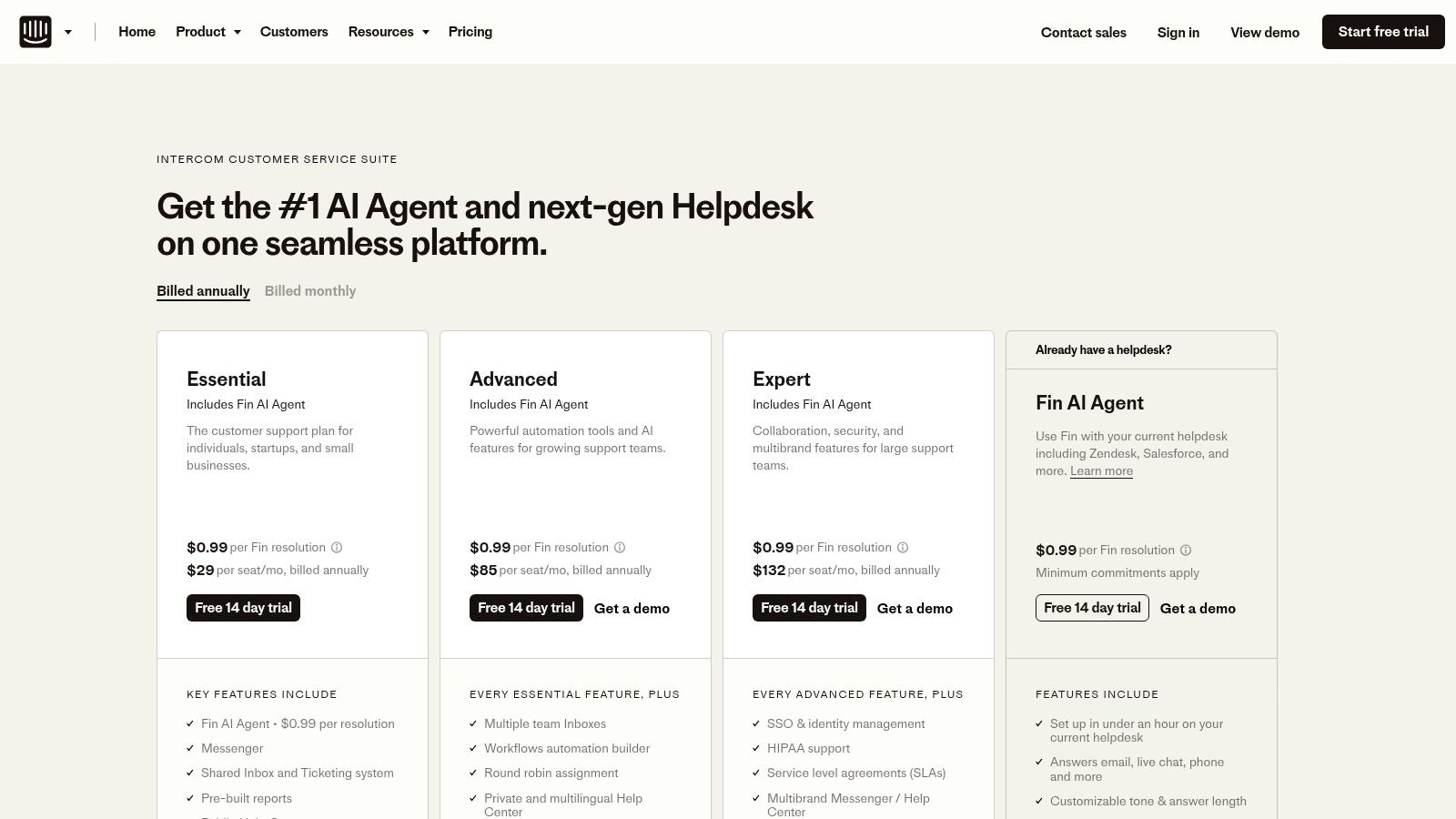
What makes Intercom unique is its seamless blend of live support, AI-powered automation, and targeted outbound messaging. For instance, you can create a segment of users who haven’t adopted a key feature after 30 days and trigger a helpful product tour or an in-app message from their account manager. The platform’s AI agent, Fin, can handle common queries instantly, freeing up human agents to focus on complex, high-value interactions that strengthen customer relationships and loyalty. This multi-pronged approach helps improve the user experience and drive product adoption, both of which are key levers for retention.
Key Features & Analysis
- Proactive Engagement Tools: Allows for targeted in-app messages, push notifications, and product tours based on user behavior and segmentation.
- Fin AI Agent: An AI chatbot that provides instant resolutions to common customer questions, priced transparently per resolved conversation.
- Shared Inbox & Ticketing: A collaborative inbox that unifies all customer communication channels, from live chat and email to social media.
- Surveys & Feedback: Enables the deployment of targeted surveys (like NPS) to gauge customer sentiment and collect actionable feedback directly within the product.
Pros:
- Strong In-App Engagement: Excellent for proactive, contextual communication that drives product adoption and user success.
- Transparent Pricing: Offers clear plan pricing and a predictable, per-resolution cost for its AI features.
- Unified Platform: Combines support, engagement, and automation into a single, user-friendly interface.
Cons:
- Scaling Costs: Pricing can increase significantly with agent headcount and the volume of AI-powered resolutions.
- Advanced Features Gated: Enterprise-level controls, such as multibrand support, are restricted to higher-tier plans.
Intercom is best suited for SaaS and e-commerce businesses that want to engage customers directly within their product to increase activation, adoption, and long-term retention.
7. Zendesk
Zendesk is a foundational customer service suite that anchors customer retention in fast, effective support. While not a dedicated customer success platform like others on this list, it serves as the operational backbone for resolving issues, which is a critical component of loyalty. This powerful piece of customer retention software excels by centralizing all customer conversations from email, chat, phone, and social media into a single, unified ticketing system. This omnichannel approach ensures agents have full context, leading to faster resolutions and higher satisfaction.
What sets Zendesk apart is its massive ecosystem and scalability. It’s designed to be the central nervous system for support operations, with powerful AI tools to deflect common questions and analytics to track team performance. For teams looking to operationalize retention through service quality, Zendesk provides the core infrastructure. Its marketplace allows you to connect specialized retention tools, effectively building a custom retention stack on top of a world-class support platform.
Key Features & Analysis
- Omnichannel Ticketing & Knowledge Base: Unifies all customer interactions into one thread and provides a self-service help center to empower customers and reduce ticket volume.
- AI Agents & Analytics (Explore): Deploys AI to automate responses, route tickets, and analyze support trends, helping identify friction points in the customer journey.
- QA & Workforce Management Add-ons: Offers specialized tools for quality assurance and staff scheduling, ensuring consistent service levels that foster loyalty.
- Marketplace & Integrations: A vast app marketplace allows seamless integration with CRMs, analytics platforms, and other business-critical software.
Pros:
- Proven Scalability: Trusted by startups and large enterprises alike to handle high volumes of support interactions.
- Broad Ecosystem: The extensive marketplace and flexible add-ons allow for deep customization to fit specific operational needs.
- User-Friendly Interface: Known for its clean and intuitive agent workspace, which reduces training time and improves efficiency.
Cons:
- Complex Plan Tiers: The distinction between “Suite” and “Support” plans can be confusing for new users.
- Incremental Costs: Advanced features like analytics, QA, and workforce management are often add-ons that increase the total cost.
Zendesk is ideal for any business that believes exceptional customer service is the cornerstone of its retention strategy, from fast-growing e-commerce stores to enterprise-level SaaS companies.
8. Braze
Braze is an enterprise-grade customer engagement platform built for real-time, cross-channel communication. While not a traditional customer success tool, it is powerful customer retention software for B2C and mobile-first B2B companies that need to execute sophisticated lifecycle marketing campaigns at massive scale. The platform excels at ingesting user behavior data and enabling brands to trigger highly personalized, automated messages across email, SMS, push notifications, and in-app messages to drive engagement and prevent churn.
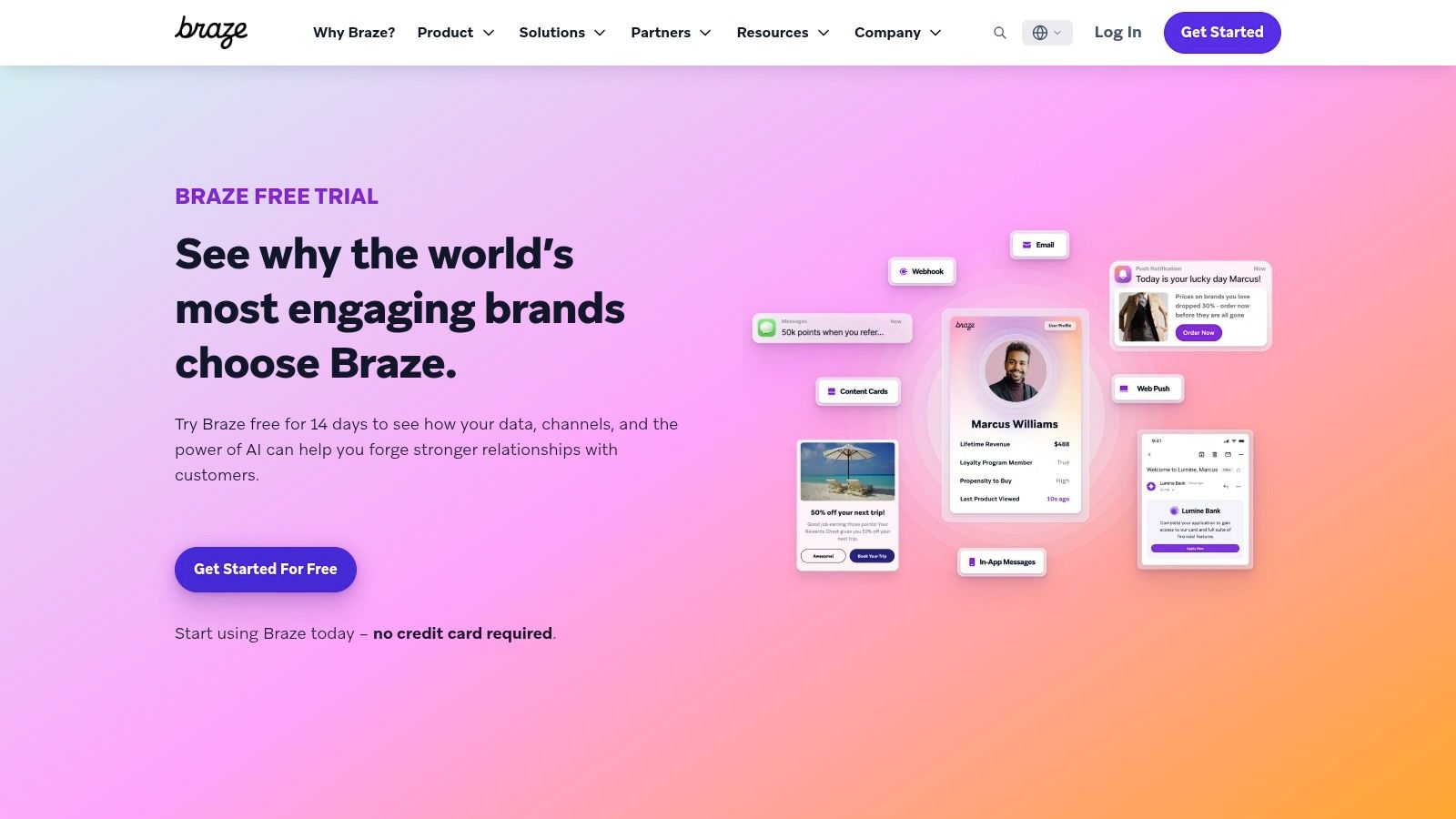
What makes Braze stand out is its visual journey builder, Canvas, combined with BrazeAI. This allows marketing and retention teams to map out complex customer journeys with branching logic based on real-time user actions. For example, you can build a workflow that sends a push notification to a user who abandoned their cart; if they don’t convert, it can follow up with a personalized email offering a discount 24 hours later. This level of orchestration is crucial for re-engaging at-risk users before they are lost.
Key Features & Analysis
- Canvas Journey Builder: A visual interface for creating, managing, and optimizing multi-step, cross-channel customer journeys based on user behavior and attributes.
- Cross-Channel Messaging: Comprehensive support for email, SMS, push notifications, in-app messages, WhatsApp, and more, allowing for a cohesive communication strategy.
- Deep SDKs/APIs & Real-Time Personalization: Robust developer tools enable the collection of rich behavioral data to power real-time message personalization at the individual user level.
- BrazeAI: A suite of AI-powered tools that helps optimize message timing, channel selection, and copy to maximize engagement and conversion for retention campaigns.
Pros:
- Designed for Massive Scale: Built to handle huge volumes of data and messages for large, consumer-facing applications.
- Sophisticated Targeting: Enables incredibly granular segmentation and real-time triggers for highly relevant communication.
- Strong Developer Ecosystem: Excellent SDKs and APIs make it a favorite for engineering-led marketing teams.
Cons:
- High-Value Pricing: Contracts are custom and typically start in the five-figure range annually, making it inaccessible for small businesses.
- Requires Technical Resources: Implementation and ongoing management often require dedicated developer or technical marketing support.
Braze is best for large-scale B2C companies or mobile-centric businesses that need a powerful, multi-channel messaging engine to drive user retention through hyper-personalized communication.
9. Klaviyo
Klaviyo is an email and SMS marketing automation platform designed primarily for e-commerce and direct-to-consumer (DTC) brands. While often seen as a marketing tool, its deep integration with shopping platforms like Shopify and BigCommerce makes it a powerful piece of customer retention software for driving repeat purchases and increasing customer lifetime value. The platform excels at unifying customer data, purchase history, and browsing behavior to fuel highly personalized communication.
What sets Klaviyo apart is its focus on fast time-to-value for e-commerce businesses. Its library of pre-built, benchmarked automation flows for scenarios like abandoned carts, win-back campaigns, and post-purchase follow-ups allows businesses to quickly implement proven retention tactics. By combining email, SMS, and push notifications within a single workflow, Klaviyo ensures you can reach customers on their preferred channel at the right moment, turning one-time buyers into loyal brand advocates.
Key Features & Analysis
- Pre-built E-commerce Flows: Offers a robust library of automated workflows for abandoned carts, browse abandonment, win-backs, and VIP customer recognition, complete with performance benchmarks.
- Deep E-commerce Integrations: Features over 350 integrations, with particularly deep connections to Shopify, Magento, and BigCommerce, pulling in granular customer and order data.
- Predictive Analytics: Uses historical data to predict churn risk, customer lifetime value, and optimal send times, enabling more strategic segmentation and targeting.
- Unified Customer Profiles: Creates a single view of each customer, combining their on-site activity, purchase history, and engagement across email and SMS channels.
Pros:
- Transparent Pricing: Offers a free tier for smaller lists and a clear, profile-based pricing model that’s easy to understand.
- Fast Time-to-Value: Pre-built templates and deep integrations allow e-commerce stores to get sophisticated retention campaigns running quickly.
- Strong SMS Capabilities: Seamlessly integrates SMS into automated flows, providing a powerful channel for immediate communication.
Cons:
- Rising Costs: The pricing model can become expensive as your list of active profiles and SMS sending volume grows.
- B2B Limitations: Less suited for complex B2B sales cycles that involve multiple stakeholders and non-linear customer journeys.
Klaviyo is the ideal solution for e-commerce and DTC brands of all sizes looking for an integrated, data-driven platform to boost customer loyalty and LTV through personalized email and SMS marketing.
10. Iterable
Iterable is a cross-channel marketing automation platform that excels as customer retention software for mid-market to enterprise companies. It empowers teams to create cohesive customer experiences across email, SMS, push notifications, and in-app messages. The platform is built on a flexible data model, allowing businesses to unify user data from various touchpoints to power highly personalized re-engagement and retention campaigns at scale.
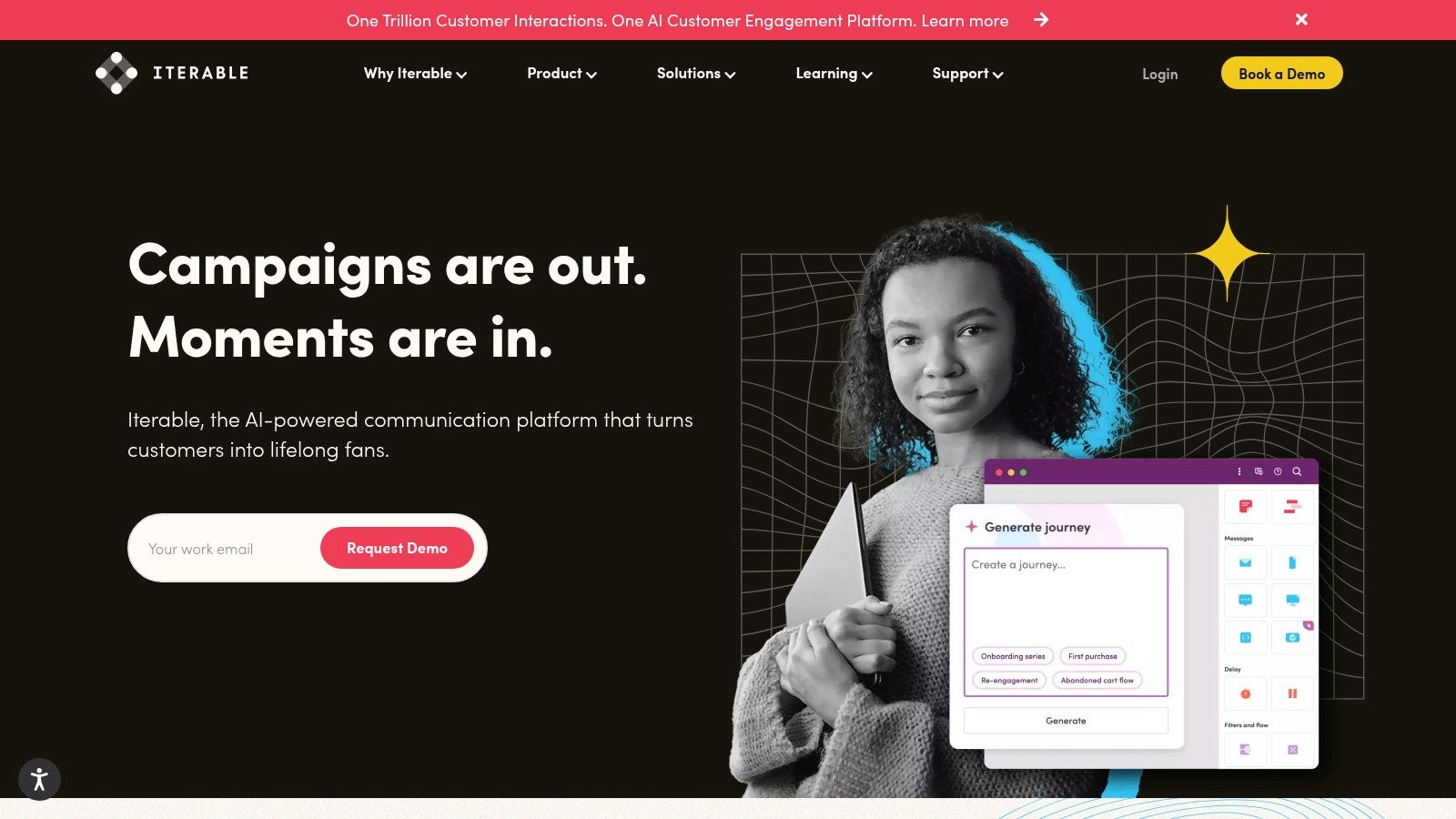
What sets Iterable apart is its visual journey builder, “Workflow Studio,” combined with robust A/B and multivariate testing capabilities. This allows marketers to design, visualize, and optimize complex, event-triggered user journeys without heavy engineering reliance. For example, you can create a workflow that sends a targeted push notification if a user abandons their cart, followed by a personalized email with product recommendations 24 hours later if they still haven’t converted. This sophisticated, multi-step approach is crucial for retaining customers in competitive markets.
Key Features & Analysis
- Workflow Studio: A drag-and-drop visual editor for building automated, cross-channel communication flows based on user behavior and data attributes.
- Advanced Segmentation & Personalization: Utilizes a flexible data model to segment audiences with precision and dynamically insert personalized content, including product catalog information.
- Experimentation Tools: Provides built-in A/B and multivariate testing for every element of a campaign, from subject lines to entire user journeys, to optimize for engagement.
- Strong API and Integrations: Offers a robust API and a wide partner ecosystem, ensuring it can connect with your existing tech stack, including CRMs, analytics tools, and helpdesks.
Pros:
- Sophisticated and Usable: Balances powerful multi-channel campaign capabilities with an intuitive interface for marketers.
- Ideal for Personalization: Excellent for product-led or e-commerce companies that need to leverage user data for advanced personalization.
- True Cross-Channel Orchestration: Seamlessly coordinates messages across different channels within a single user journey.
Cons:
- Opaque Pricing: Pricing is not public and requires a sales consultation, often including implementation fees.
- Complex Cost Model: The total cost can be difficult to predict as it depends on multiple variables like user profiles, message sends, and channel usage.
Iterable is best for growth-stage and enterprise businesses that need a powerful, integrated platform to orchestrate sophisticated retention marketing campaigns across multiple channels.
11. Salesforce AppExchange
Rather than a single tool, Salesforce AppExchange is a vast marketplace where businesses can discover and procure apps that enhance their existing Salesforce ecosystem. For companies heavily invested in Service Cloud or Data Cloud, this is a goldmine for finding specialized customer retention software that integrates natively. The platform acts as a one-stop shop for add-ons covering everything from advanced AI-powered analytics and customer success management to targeted messaging and knowledge base solutions, all designed to plug directly into your Salesforce instance.
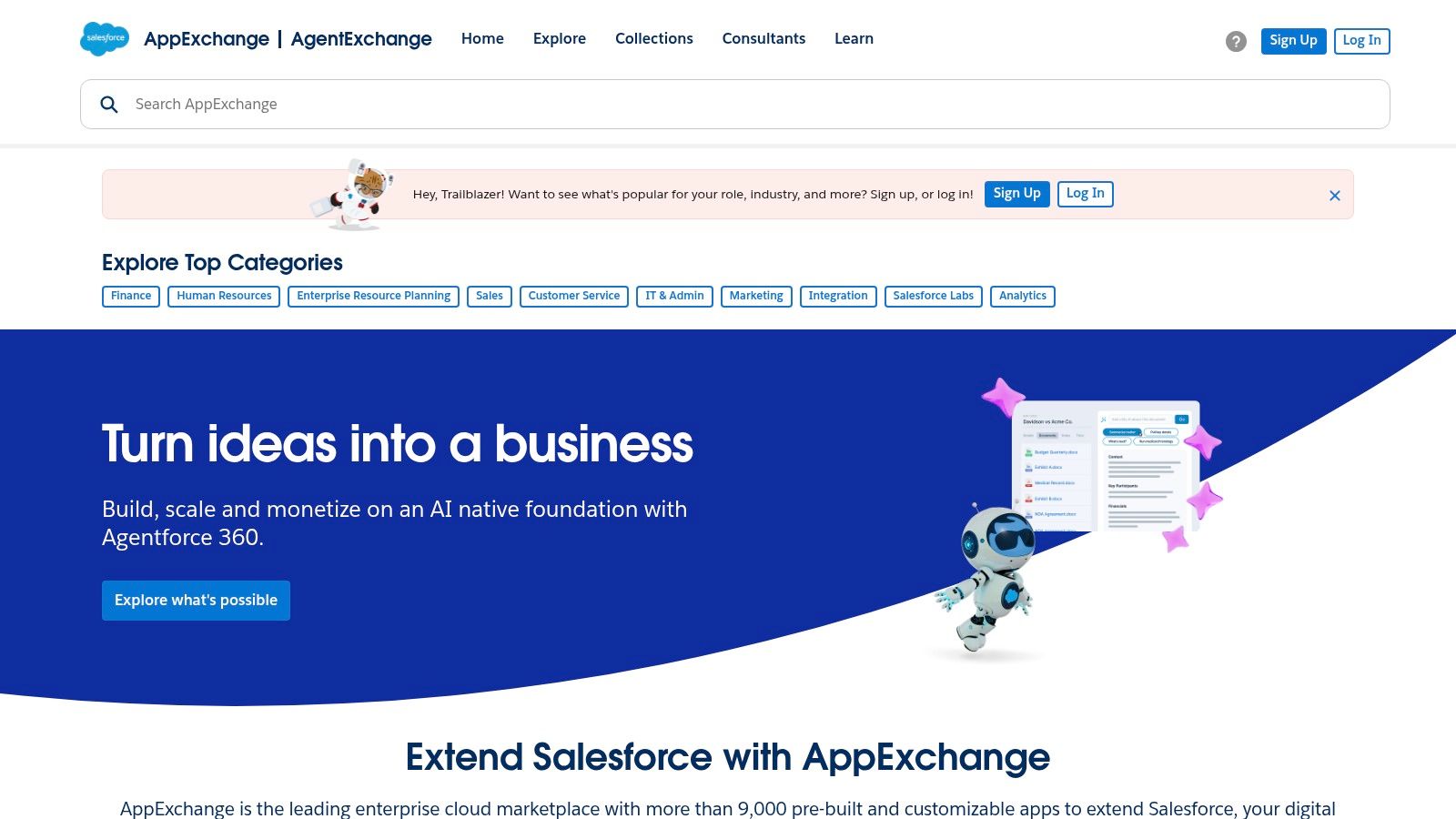
What makes the AppExchange uniquely valuable is its curation and native integration. You aren’t just browsing random tools; you’re finding solutions vetted for Salesforce compatibility. This dramatically simplifies the procurement and implementation process, as many apps can be installed with just a few clicks. The ability to read peer reviews, check security compliance, and often trial the software directly within the marketplace provides a layer of trust and convenience that standalone software searches cannot match. It also allows you to find certified implementation partners to help with deployment.
Key Features & Analysis
- Curated App Collections: Features dedicated collections for customer engagement, retention, and service, making it easy to discover relevant solutions.
- Searchable & Filterable Listings: Users can search for apps and filter by pricing models, trials, ratings, and Salesforce edition compatibility.
- Consultant & Partner Directories: Beyond software, the AppExchange lists certified consultants and implementation partners to assist with strategy and rollout.
- Native Salesforce Integration: The core value proposition is finding tools that deeply integrate with your Salesforce data and workflows, creating a unified tech stack.
Pros:
- Centralized Procurement: Streamlines the discovery, trial, and purchasing process for Salesforce customers.
- Deep Native Integrations: Ensures seamless data flow and functionality within the Salesforce ecosystem, reducing implementation friction.
- Wide Variety of Solutions: Offers a vast selection of vendors and solution types, from niche tools to enterprise-grade platforms.
Cons:
- Best Value for Salesforce Users: The primary benefit is for companies already using Salesforce; it offers less value otherwise.
- Variable Pricing: Pricing and quality vary widely by vendor, and many listings require a direct sales quote.
The Salesforce AppExchange is the ideal starting point for any business using Salesforce that wants to enhance its customer retention capabilities without the headache of complex, non-native integrations.
12. G2
G2 is not a piece of customer retention software itself, but rather an essential starting point in the research process. It’s a peer-to-peer review marketplace where real users share their experiences with business software. For anyone shortlisting tools, G2’s “Proactive Customer Retention” category provides a comprehensive landscape of available solutions, complete with crowdsourced reviews, detailed feature comparisons, and satisfaction ratings that help you look beyond marketing claims.
What makes G2 uniquely valuable is its Grid Report, which visually maps out vendors based on market presence and user satisfaction. This allows you to quickly identify industry leaders, high performers, and niche players. You can filter results by company size, industry, and specific features, making it an efficient way to build a relevant shortlist of platforms to demo. The platform operationalizes the discovery phase, turning a potentially overwhelming search into a structured evaluation.
Key Features & Analysis
- Crowdsourced User Reviews: Offers authentic, in-depth feedback from verified users, covering everything from implementation to ongoing support.
- Comparative Grids: The G2 Grid and comparison tools allow you to see how different retention tools stack up against each other on key features and satisfaction metrics.
- Detailed Filtering: Users can narrow down software options by business segment (small business, mid-market, enterprise), user satisfaction scores, and pricing availability.
- Buyer Guides & Reports: Provides editorial content and category reports that define the space and offer guidance for making an informed purchasing decision.
Pros:
- Real-User Validation: Provides honest feedback that helps verify vendor claims and uncover potential red flags before you buy.
- Efficient Discovery: A fast way to surface a wide range of alternatives and niche tools you might not otherwise find.
- Structured Comparison: The grid format simplifies the complex task of comparing dozens of software vendors.
Cons:
- Influenced Visibility: Sponsored placements and vendor marketing efforts can sometimes affect which tools are most visible.
- Outdated Information: Pricing and feature data can be incomplete or lag behind a vendor’s latest updates; always verify directly.
G2 is the best resource for teams at the beginning of their buying journey, helping them build a well-vetted shortlist of customer retention tools tailored to their specific needs.
Visit G2’s Proactive Customer Retention Category
Top 12 Customer Retention Software Comparison
| Product | Core features | UX / Quality (★) | Price / Value ( ) ) |
Target audience ( ) ) |
Unique selling point ( ) ) |
|---|---|---|---|---|---|
 Ticketdesk AI Ticketdesk AI |
AI ticket automation, smart routing, tagging, reply drafts, real‑time analytics | ★★★★★ 4.8/5 (CSAT examples) |
Free trial/demo; sales‑led; claims major ops savings |
Support managers, SaaS, e‑commerce, enterprises, startups |
Combines intelligent automation with human review; rapid setup & API |
| Gainsight | Customer 360, health scoring, playbooks, renewal forecasting | ★★★★☆ Enterprise‑grade |
Sales‑led pricing; scales mid→enterprise |
CS leaders, SaaS retention teams |
Deep CS workflows & forecasting |
| ChurnZero | AI agents, playbooks, renewals, in‑app guides, CRM integrations | ★★★★ Proactive |
Quote‑based; seats & add‑ons |
CS teams focused on churn reduction |
Proactive AI agents + strong integrations |
| Totango | AI risk detection, playbook designer, segmentation, goal management | ★★★★ Scalable |
Sales‑led; tiered packaging by maturity |
Large account volumes, complex CS orgs |
Composable engine for maturity levels |
| HubSpot Service Hub | Shared inbox, KB, surveys, workflows, HubSpot CRM integration | ★★★★☆ Easy adoption |
Free tier available; paid tiers for advanced features |
SMBs & growth teams using HubSpot CRM |
Native CRM alignment & extensive free tools |
| Intercom | Fin AI agent, in‑app messaging, product tours, workflows | ★★★★ Strong engagement |
Transparent plans; AI per‑resolution pricing |
Product & support teams focusing on in‑app UX |
Best‑in‑class in‑app automation & per‑resolution AI |
| Zendesk | Omni‑channel ticketing, AI/Copilot, analytics, marketplace | ★★★★☆ Proven at scale |
Tiered pricing; add‑ons (WFM/QA) add cost |
Large support operations, enterprises |
Broad ecosystem & advanced ops add‑ons |
| Braze | Canvas journeys, cross‑channel messaging, real‑time personalization | ★★★★★ High performance |
Enterprise (typically high‑value contracts) |
Enterprise lifecycle & marketing teams |
Real‑time personalization at scale |
| Klaviyo | Email/SMS flows, ecommerce templates, predictive models | ★★★★ Ecommerce‑focused |
Freemium; profile‑based pricing |
Ecommerce & DTC brands |
Fast time‑to‑value for repeat purchase/LTV |
| Iterable | Visual journey builder, experimentation, flexible data model | ★★★★ Flexible |
Sales‑led; pricing by profiles/usage |
Mid‑market to enterprise marketers |
Flexible data model + experimentation |
| Salesforce AppExchange | Curated apps, trials, partner directory, native integrations | ★★★★ Vendor‑dependent |
Varies by vendor; many quote‑based |
Salesforce customers & implementers |
Centralized procurement + native Salesforce apps |
| G2 | Crowdsourced reviews, comparison grids, filters, buyer guides | ★★★★ Buyer insights |
Free to browse; vendor‑sponsored placements |
Buyers researching software |
Real‑user reviews & shortlisting tools |
Choosing the Right Retention Software for Your Business
Navigating the extensive landscape of customer retention software can feel overwhelming, but the journey to finding the perfect fit is a strategic investment in your company’s future. Throughout this guide, we’ve explored a diverse range of platforms, from dedicated customer success giants like Gainsight and ChurnZero to marketing automation powerhouses such as Klaviyo and Braze. The key takeaway is clear: there is no single “best” solution for every business. The right choice is deeply contextual, hinging on your unique business model, customer journey, and operational maturity.
Your primary goal should be to move beyond a simple comparison of features and instead evaluate these tools through the lens of your specific retention challenges. A feature that is revolutionary for a B2B SaaS company might be completely irrelevant for a high-volume e-commerce store. The most effective approach begins with a clear internal audit of your needs.
From Evaluation to Implementation: Your Action Plan
To transition from reading this guide to making a confident decision, follow these actionable steps. This structured process will help you create a shortlist and select the customer retention software that will genuinely move the needle for your business.
-
Define Your Core Retention Drivers: What are the top 1-3 reasons customers stay with you? Is it your proactive support, seamless product experience, or personalized communication? Answering this helps you prioritize platforms that enhance your strengths. For instance, if stellar support is your key differentiator, an AI-enhanced helpdesk like Ticketdesk AI might be your most critical investment.
-
Identify Your Biggest Churn Risks: Conversely, where are you losing customers? Is it during onboarding, due to a lack of feature adoption, or because of poor communication? A tool like ChurnZero excels at identifying these friction points, while HubSpot Service Hub can help streamline the entire customer service lifecycle.
-
Map Your Existing Tech Stack: The most powerful software is useless if it doesn’t integrate with your current tools. Create a list of your essential platforms (CRM, helpdesk, email marketing, analytics) and use it as a non-negotiable checklist. Evaluate how deeply each potential tool integrates. Does it offer a simple one-way data sync or a robust, bi-directional connection?
-
Run Use-Case-Specific Demos: Don’t let sales teams guide your demos with their standard script. Approach each demo with 2-3 of your most critical use cases. For example, ask them to show you exactly how their platform would automate an outreach campaign for users who haven’t logged in for 30 days. This practical approach cuts through marketing fluff and reveals true capabilities.
Thinking Beyond the Platform: Broader Retention Strategy
Implementing new customer retention software is just one piece of the puzzle. True retention is a company-wide culture, not just a software function. As you adopt these powerful tools, remember that they are designed to augment your team’s efforts, not replace the human element of building relationships.
Furthermore, proactive retention extends beyond direct customer interactions. Your public brand perception plays a crucial role in how customers view your long-term value and trustworthiness. Beyond core retention platforms, businesses should also consider complementary tools that help maintain a strong brand image.
Ultimately, the right customer retention software will empower your teams with the data and automation needed to act proactively, turning potential churn risks into opportunities for re-engagement. By aligning your choice with your specific business needs and integrating it thoughtfully into your workflow, you can build a more resilient, profitable, and customer-centric organization. The journey begins now.

Ready to get started?
Join hundreds of teams using Ticketdesk AI to deliver exceptional customer support.