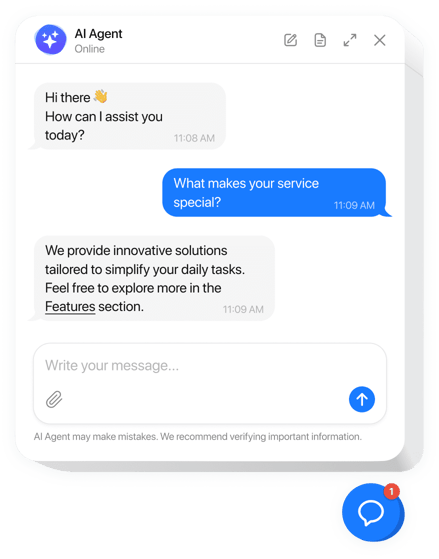
Step-by-step guide to create your first AI agent in Ticketdesk AI to automate replies, classify tickets, and assist your support team.
An AI agent in Ticketdesk AI is a virtual support representative trained on your own knowledge base. Once created, it can read incoming tickets, generate replies, set priorities, apply tags, and even close tickets, all based on rules you define.
In this guide, I will walk you through how to create your first AI agent and get it ready to start handling customer support tickets.
Create a New Agent
Before you can train or automate anything, you need to create the agent itself. Think of the agent as the brain that powers all the automations and replies. Once it is created, you can keep adding knowledge sources, tweak its behaviour, and connect it to your inbox.
- Login to your Ticketdesk AI account.
- Go to Setup > Agents.
- Click Create Agent.
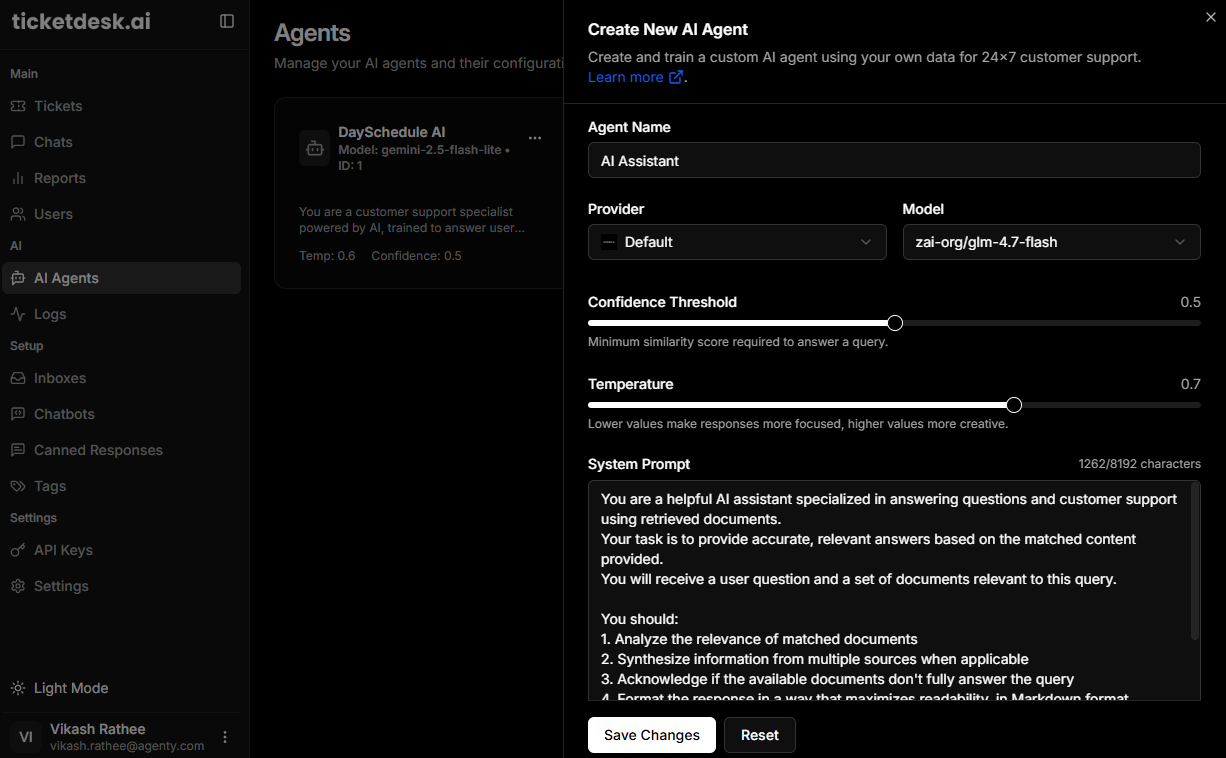
- Enter a name for your agent, for example Support Bot or Sales Assistant.
- Pick the AI provider and model you want to use, for example OpenAI GPT-4 or the default model bundled with Ticketdesk AI.
- Save the agent.
Choose a Provider and Model
The provider is the AI service that powers your agent. Some providers like OpenAI, Anthropic, or Google require their own API key, while the default Ticketdesk AI provider works out of the box with no extra setup.
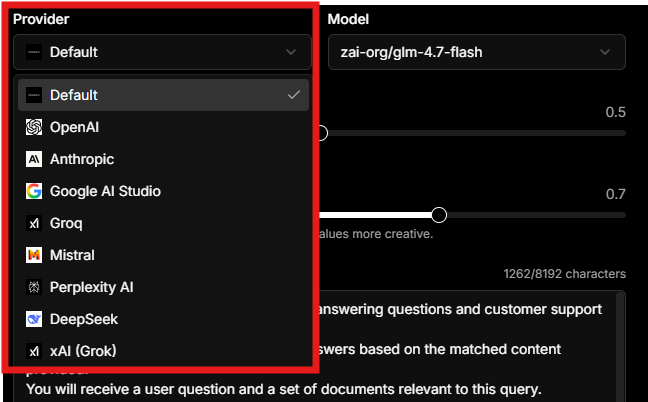
If you select a provider that needs an API key, you will see an API Key field appear right below the model selector. Paste your key there and save the agent to bring your own models and advanced AI.
Set Confidence and Temperature
Once the agent is created, you can fine tune how it responds:
- Confidence Threshold controls the minimum similarity score required for the agent to answer a query. A higher value means the agent only replies when it is very sure, lower values make it more willing to attempt an answer.
- Temperature controls how creative the responses are. Lower values produce focused, predictable answers, higher values make the responses more varied and creative.
For most customer support cases, a confidence around 0.5 and a temperature around 0.7 is a good starting point.
Write a System Prompt
The system prompt defines the personality, tone, and role of your agent. This is where you tell the agent who it is, what it should do, and how it should behave with your customers.
A simple example:
You are a helpful support agent for Acme Inc. Always reply in a friendly,
professional tone. If you do not know the answer, ask the customer for
more details instead of guessing.
You can use up to 8192 characters for the prompt. Keep it clear and specific to your business.
Next Steps
Your agent is now created but it does not know anything about your business yet. The next step is to add knowledge sources so it can learn from your help docs, websites, and PDFs.
You can also jump straight to setting up automations if you want to define how and when the agent acts on tickets.